Check on any given online forum focused on the AR-15/M4, or really any gun board, and you’ll likely find a debate over using ACOGs in a world full of red dots and Low Power Variable Optics (LPVO). One of the earliest questions to appear on The Everyday Marksman’s Community Forum dealt with this exact issue.
A Note from Matt
If you didn’t catch the by-line on this article, it’s not by me. I’d like to welcome Diceman624, one of our own community members, to the ranks of those who have published articles on the site. All members are able to submit articles for publishing, and I look forward to doing this more!
This article contains affiliate links.
The Setup
Internet reputations may be one thing, but cold hard data is another.
Having the means, I wanted to see for myself, so I decided to act on it.
One of the often-cited shortcomings of the ACOG is its weakness at Close Quarters ranges. Experts and competitors alike speak to the effectiveness of red dots in these short distances, and that reputation is well-deserved. The question remained whether I could even employ an ACOG that close.
I devised a test pitting my Aimpoint PRO mounted to a 1:9 twist upper against my smallest ACOG, a 3×24 TA-50 attached to a 1:7 twist mid-length upper.


I planned to test both against a shot timer to determine how well and how fast each optic could perform at 10 yards. This represents the longest possible shot inside my home in the event of a defensive situation.
However, as with all best laid plans, Murphy gets a vote.
I was forced to use an indoor range for testing, which nullified my shot timer. While unable to get hard data, I continued to test knowing I could get some impressions just by doing. What follows are those impressions.
Part II will follow once I get my data from working the shot timer
Testing Protocol
Internet reputations may be one thing, but cold hard data is another.
Diceman Tweet That
The test is simple: from the low ready, engage 1-second presentations of an USPSA/IDPA paper target at 10 yards, with three second gaps.
For control measures, I used the same ammunition, magazine and lower assembly.
There are two notable factors to consider:
- My PRO is set to a 50-yd zero while…
- The ACOG is set to 100-yd.
Prior to starting, I used the range’s provided B27 silhouette target to get a feel for Point-of-Aim/Point-of-Impact drop.
As you can see, the POA/POI shift is noteworthy.
I fired in the order of PRO, ACOG and then irons last. I used the irons cowitnessed through the PRO, with the optic turned off.
This brought about its own learning point.

I’ll take a moment to explain my expectations for the ACOG.
It’s advertised as a combat optic, so I expect it to provide combat effective accuracy at ranges from 5 to 500 yards. I don’t expect to help me make one-inch groups at 100 yards– it’s just not the optic for that.
I don’t expect it to be as fast as the PRO, but I do expect it to work good enough to engage a target at 10 yards, in this case, with reasonable speed.
The PRO Run
I started running the PRO for what should’ve been five presentations, when I ran into two problems. First, the range’s equipment couldn’t present a target for shorter than 1 second. I originally wanted a half second presentation.
Five presentations eventually turned to thirteen as I figured out my range equipment limitations.
Next, I fired the first two with the PRO turned off, forgetting I had done so earlier in order to use the irons. After correcting and learning from these issues, I resumed testing for a total of thirteen shots.
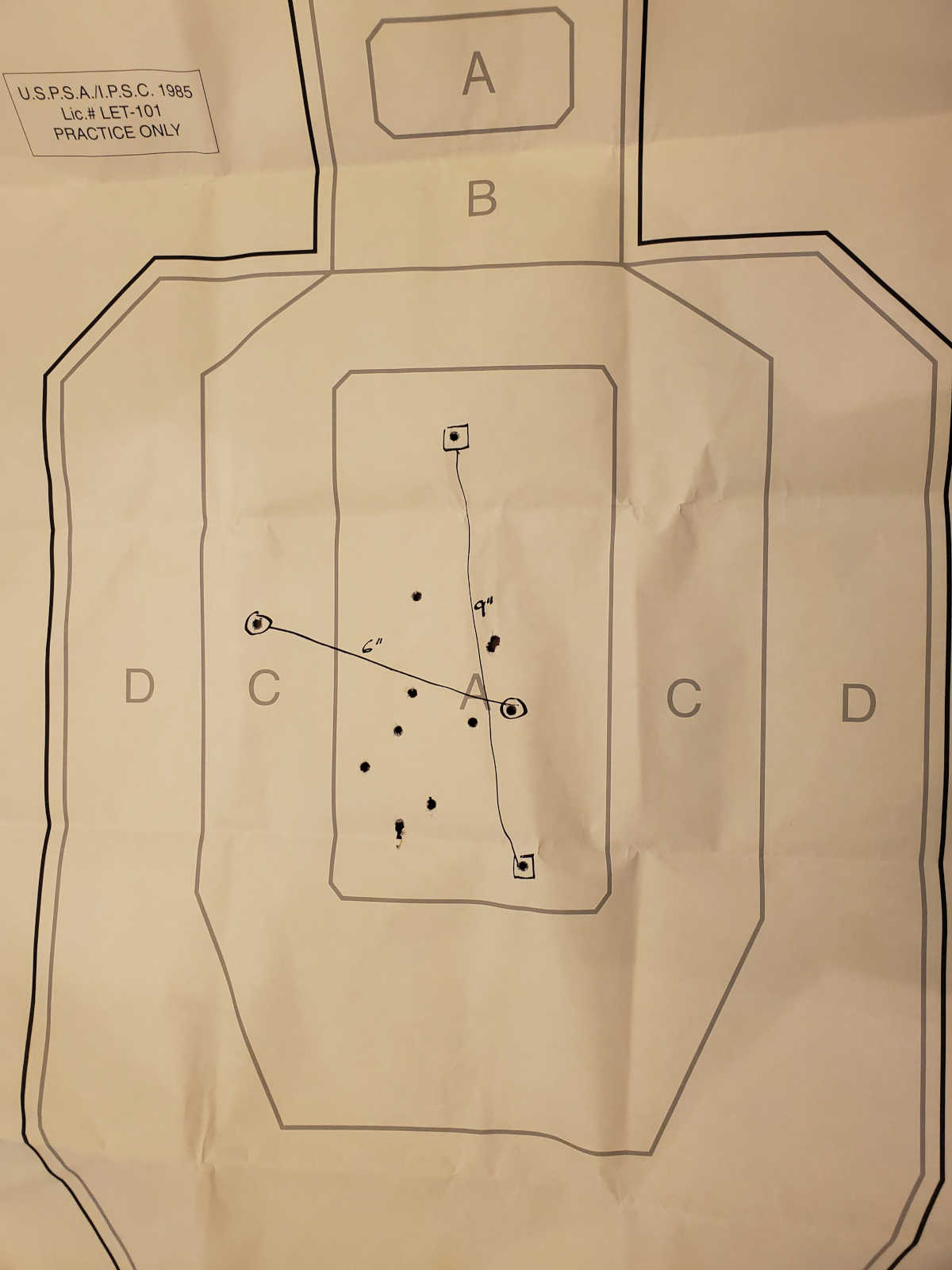
As you can see, the PRO produced a nice pattern of hits in the A-zone; I consider these combat effective hits. The PRO felt fast, even off, making a nice aperture for an FSB. I certainly feel confident running the PRO as my home defense optic.
The ACOG Run
This is where things got interesting.
Earlier that morning, I used the Exterior Ballistic Calculator V2 app to determine approximately where on the ACOG reticle to aim. If you look on Trijicon’s website, for my crosshair reticle, I should’ve aimed at the absolute base of it, at the 700-yard mark.
The exact aiming point is circled in green.
There are significant differences compared to the PRO target.
The pattern grew in size and shifted left by a few inches. Remember that left eye/right hand dominance thing? It played a role here.
However, all ten shots are on target. I get it, it’s ten yards, but 9 of the 10 are still combat effective hits on the target. With training and continued refinement of technique, I feel I can get faster and center that pattern. Not to mention, I can remember to use the appropriate aiming point, the 700-yard hash, in a similar manner to a red dot.


Conclusions
The PRO certainly is easy to use outright, but I wouldn’t dismiss the ACOG just yet. With dedicated practice, I think I can get an ACOG up to near par speeds.
What remains to be seen, and what I hope to show in Part II, is the actual speed difference between the ACOG and PRO.
Cheers!


@Diceman624 I’m assuming you used the Bindon Aiming Concept to get the ACOG hits? I’ve noticed a left-to-right POA/POI shift myself when practicing BAC. I wouldn’t consider that to be much of a factor, personally. Like you said, your shots were overwhelmingly on target, and tightening them up will only bring the few ‘misses’ back into the C-zone.
I was, and this was my first attempt ever at applying it in live fire. In addition, I also have a tendancy to throw my first pistol shot from a draw well to the left if I haven’t praticed recently. I chalk that up to cross dominance issues with left-eye/right-hand biomechanics.
The shift in POI when using the Bindon Aiming Concept is a very real phenomenon. It’s related to something called phoria. Each eye may not be looking at exactly the same spot, but we usually don’t notice when we’re not looking through optics. When one eye is suddenly magnified and the other is not, then the effect becomes exaggerated. The severity of the effect varies from person to person.
Because of this, I don’t consider the BAC all that useful beyond CQB distances.
One of the things I remember from a few months ago, reading up on BAC, was that cross-dominance shooting may exaggerate the effect. That’s what I concluded caused this issue, with the near-vertical 13.5-inch string on the target. What I need to test, in order to verify, is whether my shots would be equally offset to the right if I used my left (dominant) eye.
I should also test my one LPVO to see if it produces similar results.
I don’t think the LPVO would be much different, since that’s what I noticed it on myself, and I was at 1x.
Mine will likely be worse, since its low end is 1.25x.
As a Marine, I have a fair amount of experience behind an M4 / ACOG combo. The first time I qualified, we were still using A2’s and irons. Jump forward eight years to my FAC tour and I got an M4 with an ACOG and it made the known distance (KD) range stupid easy. As long as your target is dumb enough to stand in place and silohette himself for an extended period of time, you’ll look like Vasiley Zeitsef. For close range (25m and in) stuff, it isn’t perfect but the ACOG works fine. I was part of an ANGLICO and we had lots of time and latitude to plan and conduct our own training. One of my friends in the company was an avid shooter and when we weren’t coordinating CAS shoots, he put together several practical shooting ranges for us. We traded some JTAC instructors to the Recon Bn and had some of their combat marksmanship instructors come run two of our ranges. Those guys could shoot lights out from 5m to 500m and virtually all of them ran issued M4s with ACOGs. The average Marine can get combat effective hits in CQB using the BAC. The Recon guys could regularly put a 1″ hammer pair into the “T” Box at CQB distances in remarkably fast times. The biggest issue with the BAC and the ACOG is the eye box on the TA31. 1.5″ of eye relief is NOT forgiving of mistakes. Even the slightest misplacement of… Read more »