As I write up this post in May of 2026, I’ve decided to compete in a CMP EIC Service Revolver match. The event takes place in October 2026, and I’ve got a lot of work to do. Normally, CMP pistol matches follow the same rules and sequence as an NRA bullseye match- even using the same targets. The CMP EIC Service Revolver match uses a slightly different course of fire compared to the standard since it uses two stages of slow fire and you only fire the course one time through rather than aggregating over several runs.
The President’s Match
According to lore, the President’s Pistol Course first appeared in 1981, as opposed to the classic bullseye style matches that have been around in their current form since 1904. The name “President’s Match” comes from the tradition of the President of the United States sending a letter of congratulations to the match winner at Camp Perry each year. The top 100 shooters for the year also receive an award designating them as part of the President’s 100.
Obviously, winning the overall match is a tall ask for just about any average shooter, but aiming to get a score that puts you in contention for the President’s 100 is a worthy goal.
Distinguished Revolver
As mentioned, I’m going to compete in the Service Revolver EIC match. The long-term goal is earning at least one level of Distinguished Revolver badge. To do that, I need to earn at least 30 “leg points” from shooting these matches. Of note, you can only earn a maximum of 10 points per match at a time, and I only have access to two matches per year. I say “long term” because this will probably take 3-4 years to achieve.

That reminds me, I started myself along this path with rifle years ago by competing (and winning) an EIC match at my base. Perhaps it’s something I should pursue again?
Why Revolver?
I suppose I should address this question while I’m at it. Why compete in revolver instead of service pistol or rimfire? The main reason is, “why not?”
Second to that, my “service pistol” eligible guns like the Beretta 92A1 and 1911 both have trigger pulls too light to follow the rules. The rules state a minimum trigger pull of 4.0 lbs in single action, and all of my service pistols have pulls around 3.0 to 3.5 lbs.
My Ruger Mark IV does qualify for rimfire, though. So that’s an option.
The other reason for me to go for revolver is that I’m already set up to load my own ammunition. I’ve developed a nice little load of 3.1gr HP-38 under a Hornady 148gr hollow-base wadcutter (HBWC) for my GP100.
The President’s Course of Fire
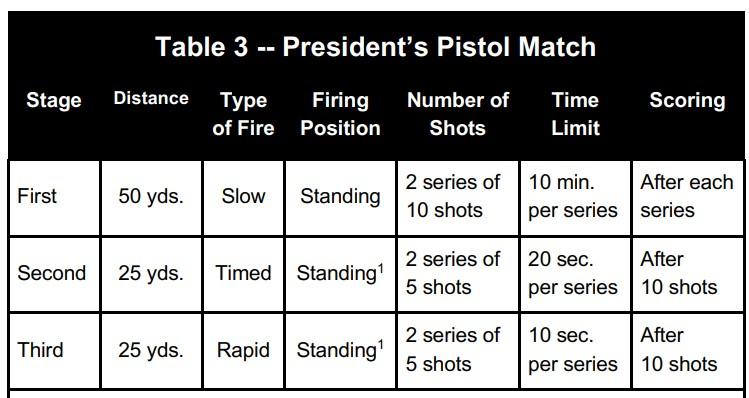
With all of that pretext out of the way, let’s discuss the actual course of fire. The President’s Course is essentially the same as an NRA bullseye and CMP Trophy course of fire with one important exception.
- 10 shots in 10 minutes at 50 yards
- 10 shots in 10 minutes at 50 yards (this is the change, an added 10 shots slow fire)
- 2 x 5 shots in 20 seconds at 25 yards
- 2 x 5 shots in 10 seconds at 25 yards
All stages shot from standing with strong hand only. Traditional bullseye courses take 30 shots to run through. 10 shots at 50 yards with a 10 minute limit, then the timed and rapid fire stages at 25. The President’s Course adds a second string of 10 shots at 50 yards for a total of 40 shots. Also, you only fire the President’s course one time. Unlike other matches of this style fired several times to build an aggregate score, this one only goes one time through.
Traditionally you would use the NRA B-6 for 50 yards and the B-8 for 25 yards.
The Everyday Marksman Modification
In my effort to standardize the targets we use for training and competition, I don’t want to make you go out and buy the B-6 target. So just as we did a tweak of the traditional NRA Bullseye course of fire for the precision pistol course, we’ll make a small adjustment for the President’s Course. This one is easy, though.
The only change is that instead of using the B-6 target at 50 yards, we’re just going to use the B-8 again. The B-8 and B-6 targets have the exact same dimensions on the scoring rings. The main difference between them is that the B-6 has the black zone extend out to the 8-ring.
| Ring Value | B-6 Diameter | B-8 Diameter |
|---|---|---|
| X | 1.695″ | 1.695″ |
| 10 | 3.36″ | 3.36″ |
| 9 | 5.54″ | 5.54″ ** |
| 8 | 8.00″ ** | 8.00″ |
| 7 | 11.00″ | 11.00″ |
| 6 | 14.80″ | 14.80″ |
| 5 | 19.68″ | 19.68″ |
That’s the only difference: use the B-8 at 50 yards. Of course, that means you need a 50-yard range, and the ability to keep your hits on the paper at that distance. If those are not available, you can get a stack of B-16 targets for doing slow fire at 25 yards.

Setting Goals
While I’m specifically aiming to perform this within the service revolver division, you can use the same course of fire (or portions of it) for any pistol in your stable. As written, there are 400 possible points. Benchmarks to work towards include:
- Minimum Capable Citizen: 320 points
- Martial Marksman: 360 points
Of note, a performance over 340 or so is likely to get you into President’s 100 territory. A score of 360 or better is an expert-level application, though not necessarily match-winning (380+ points).