This drill has origins with MSG Paul Howe of CSAT. It covers just about every aspect of rifle marksmanship, and includes an element of physical fitness to it. The downside is that in order to perform it, you’re going to need a private range where you can freely move back and forth. As you can probably guess from the name of the drill, it involves shooting at distances between 100 yards and 7 yards from the target.
I particularly like the way Paul Howe sets this one up to run multiple times so that you develop an aggregate score. Because of the relatively low round count (50 shots if done in full), it’s also light on ammunition demand and you can run it with a minimum of support equipment.
Setting up and Performing the 100 to 7
Set up your target at a distance of 100 yards. By the book, the target should be a bullseye type such as three TQ-4 targets stacked vertically, or the A-25/3 (which has three bullseyes on it already).
Then move back to the 100 yard line and perform the following sequence, jogging to each position as you advance:
- 100 yards: fire one shot at the bottom target from prone
- 75 yards: fire one shot at the bottom target from kneeling
- 50 yards: fire one shot at the middle target from kneeling
- 25 yards: fire one shot at the middle target from standing
- 7 yards: fire one shot at the top target from standing
Then jog back to the 100 yard line and repeat the process for a total of 10 times. By the time you’ve completed all 10 rounds, you will have fired 50 shots and covered 2,000 yards of movement. Paul suggests making it a goal to complete all 10 rounds in less than 20 minutes.
| Distance | Target Location | Position | Shots |
|---|---|---|---|
| 100 Yards | Bottom Bullseye | Prone | 1 |
| 75 Yards | Bottom Bullseye | Kneeling | 1 |
| 50 Yards | Middle Bullseye | Kneeling | 1 |
| 25 Yards | Middle Bullseye | Standing | 1 |
| 7 Yards | Top Bullseye | Standing | 1 |
Scoring and Performance
Paul does not provide standards in his book, and there are a lot of ways you can score this. We’ll start with the simplest method, and then work towards the more difficult.
Simple Scoring
The simplest way to score this is by counting hits and misses in the 8″ black of the TQ-4 target. This is the most realistic, and puts a priority on speed (with good enough accuracy) over absolute accuracy.
For simple scoring your goal should be to place at least 45 out of 50 hits in the black zones of the target (assuming we count 10 points per hit in the black).
Point Scoring
With point scoring, you keep the same setup, but count the point values of the target rings and add them up. For a passing standard, try to beat 400 points, while the Martial Marksman standard is 450 points.
Alternate Targets & Methods
This drill lends itself well to many different ways to run it. Bullseye targets aside, here are some of my favorite alternatives.
IPSC Turtle & “Head Target”
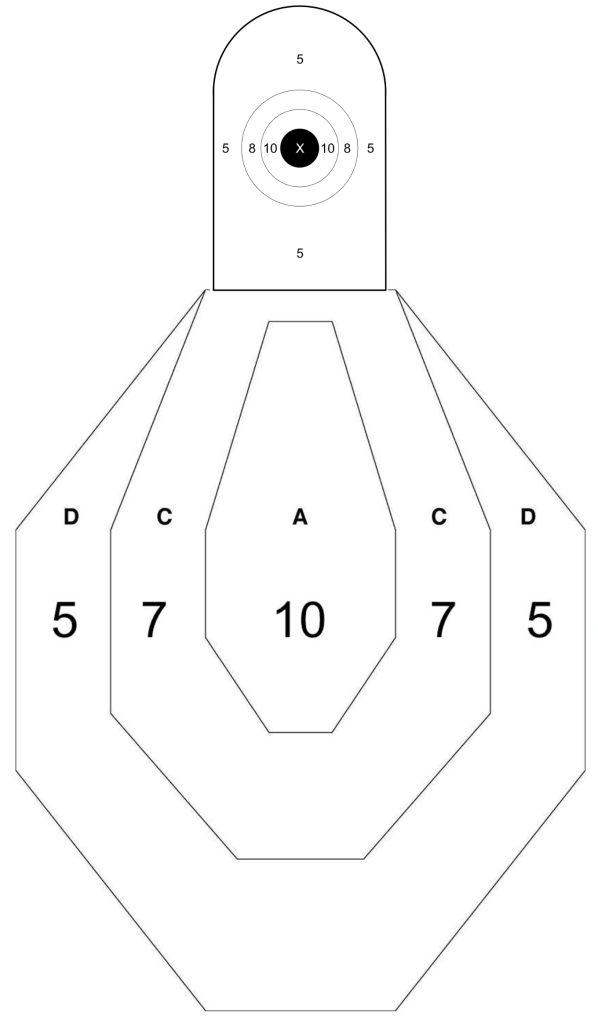
Instead of three TQ-4 bullseyes downrange, place one IPSC ‘Turtle’ target to represent a body, and then some other target above it to represent a headshot. I suggest the AP-2 tombstone or maybe the black zone of a B-8 repair center. Whichever target you use to represent the “head,” be consistent in how you use it and score it. For example, is a hit anywhere on the 5″ wide AP-2 tombstone a ‘win’ or do you have to put it within the 3.3″ b-ring? Or maybe you use point value of 5 on the tombstone, 8 for the b-ring, and 10 for the x and a-ring. For the B-8, is it any hit within the 5.5″ black or do you use the scoring rings?
For execution, do it the same way as you did for the TQ-4, but shoot at the IPSC target for the 100, 75, 50, and 25-yard distances (scoring hits to the a-zone as 10, c-zone as 7, and d-zone as 5), and then fire at the head target from 7 yards.
IALEFI-QT Paper Target
This particular target is another great fit for this drill. It has both an 8″ and 10″ center mass zone as well as a 4.5″ head shot zone. Run it exactly as described for the IPSC & Head Target procedure, doing 100, 75, 50, and 25-yard shots at the center mass zone and the 7-yard shot at the head zone. Score hits however you like.
Adding Transitions
As one final twist to this, once you’ve gotten proficient with the rifle, consider adding a pistol to this drill. Take shots at the 100, 75, 50, and 25-yard line with your rifle and then transition to a pistol for the 7-yard head shot.
Adding Reloads
As written, this drill does not consume enough ammunition to need much in the way of magazine changes- but you can still add them in yourself. Consider selecting a part of the drill, say after taking the 50-yard shot, where you have to perform a reload before taking a shot at 25 yards. You can do that on-the-move, or do it before/after movement. Whatever your skill level allows.
Hit Factor Scoring
This drill also lends itself well to hit factor scoring, though using minutes instead of seconds. Take your total aggregate point score and divide it by the number of minutes it took you to complete the course of fire.
Closing Out
I like this drill because it covers the bases and is easily modified for added challenge. It also teaches you to manage your sight offsets for each distance.
Whichever scoring method you choose, be sure to stick with it for a while and chart your progress. I suggest also keeping track of how long it takes you to complete it. That way, you have both a raw score and a time goal to beat each time you perform it.