Today we’re introducing another rifle drill. This one is based on the Modified Navy Qualification (MNQ) popularized by the late Pat Rogers. It made routine appearances in his courses. Other trainers, like Jeff Gonzales (of Trident Concepts), use it as well. The origins apparently go back to a more extensive qualification used by the Navy SEAL teams prior to 9/11. From what I can find, there are many variations of it. Today we’re defining a standard one for our community to use as a training tool. I’ve updated it to use a standard target and simpler scoring mechanism.
This drill is simple, and takes place at 50 yards. You use 15 rounds per run, and I suggest running it three times back to back to develop an aggregate score.
This is not a drill you use for competition, but rather as a diagnostic of your shooting. It pairs really well after a period of practicing the basic rifle marksmanship course of fire as a way to evaluate your progress.
Drill Execution
The “traditional” way to run this is with an 8″ target, which could be an IDPA silhouette, the 8″ black of a TQ-4 target, or the 8″ circle of the IALEFI-QT. All three of these are ones I suggest keeping on hand. The idea of the 8″ circle is a pure hit/miss standard where you count hits in the circle and hits outside.
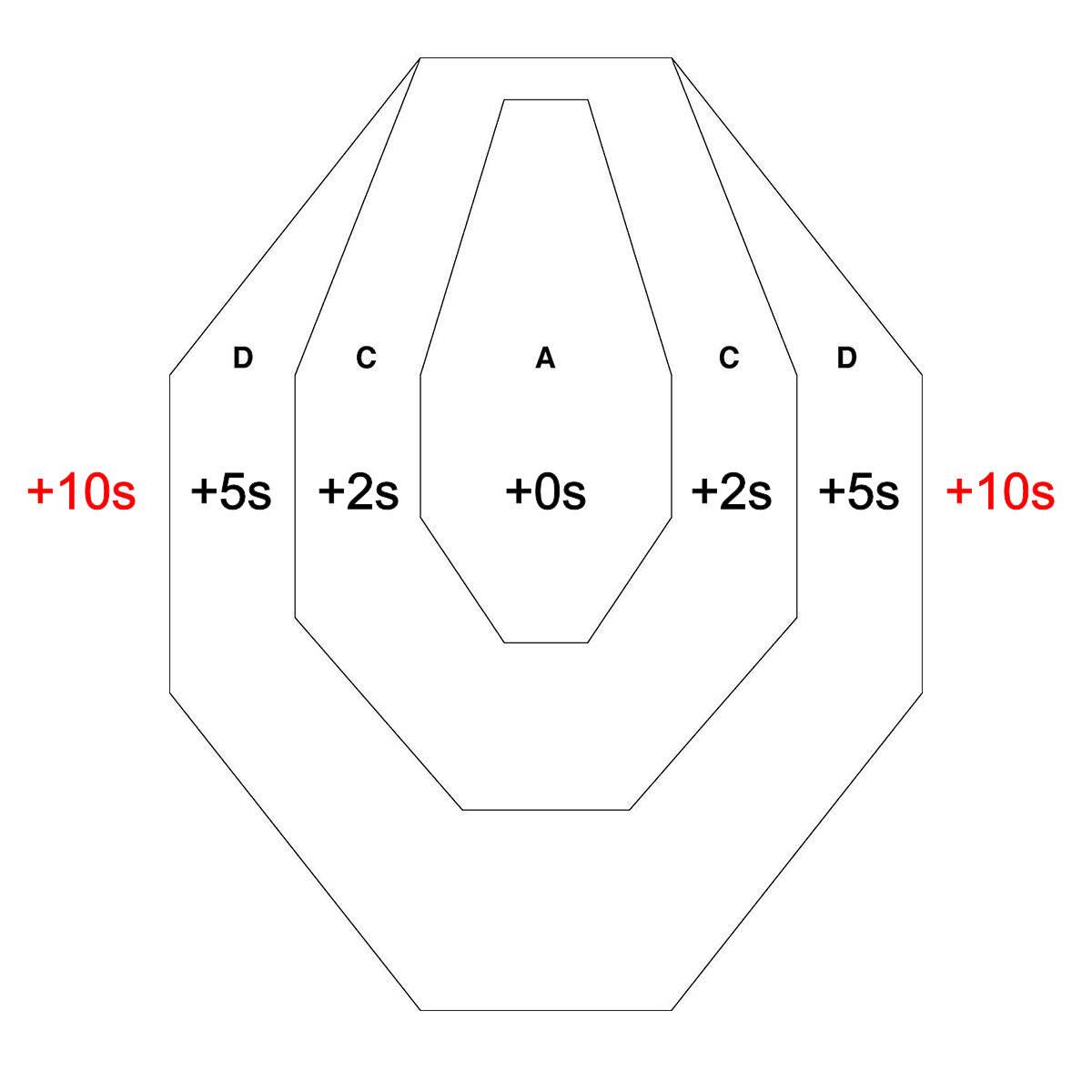
For my version, though, I suggest the IPSC Classic “Turtle” target because I leverage the A/C/D scoring zones.
Place the target at 50 yards. Load three magazines with 5 rounds each and start at the low ready position. Performing this drill requires a shot timer. The drill is designed around a semi-automatic rifle, but you could use a manual action if it’s all you had. Be sure to document the rifle you use in your training log.
On start, fire five rounds from standing, reload and fire five rounds from kneeling, reload and fire five rounds from prone.
Scoring
This drill uses a time-plus scoring: your score for the run is your raw time plus time penalties based on where each shot hits.
Penalties per hit
- A-zone: +0 seconds
- C-zone: +2 seconds each
- D-zone: +5 seconds each
- Off target (outside the D-zone): +10 seconds each
Example
Let’s say your raw time is 22.00 seconds. When you score the target, you have:
- 8 A-zone hits
- 4 C-zone hits
- 2 D-zone hits
- 1 off-target hit
Penalty time
- 8 x 0 = 0 seconds
- 4 x 2 = 8 seconds
- 2 x 5 = 10 seconds
- 1 x 10 = 10 seconds
Total penalties = 28 seconds
Final score = 22.00 + 28 = 50
So your score for that run is 50.00 (and lower is better).
Aggregate Scoring
That was for one run through. I suggest running this drill three times back to back, then adding up all three runs for a final score. So let’s say you did 50 on the first run, 38 on the second, and 42 on the third. Your final score for the day is 50 + 38 + 42 = 130.
Benchmarks
Remember, this drill is scored as lower is better (time + penalties). The benchmarks below are intended for a semiautomatic rifle.
You can absolutely run this with a bolt action or lever action, but your score will naturally be higher. If you’re running a manual action, treat these numbers as reference points, not requirements. The goal is tracking your progress over time.
- Excellent: ≤ 30 in a single run, or ≤ 90 for a three-run aggregate.
- Good: ≤ 40 for a single run, or ≤ 120 for a three-run aggregate.
- Passing: ≤ 50 for a single run, or ≤ 150 for a three-run aggregate.
- Fail: > 50 for a single run, or > 150 for a three-run aggregate
The 5-5-5 Carbine Field Test
50 Yards | 15 Rounds | IPSC Classic Target
| Phase / Zone | Metric | Execution & Details |
|---|---|---|
| Course of Fire | ||
| 1. Standing | 5 Rounds | Start Low Ready. On the timer, fire 5 rounds standing. |
| 2. Kneeling | 5 Rounds | Mandatory Reload. Drop to kneeling and fire 5 rounds. |
| 3. Prone | 5 Rounds | Mandatory Reload. Drop to prone and fire 5 rounds. |
| Scoring & Penalties (Time-Plus) | ||
| A-Zone | +0 Seconds | |
| C-Zone | +2 Seconds | |
| D-Zone | +5 Seconds | |
| Miss | +10 Seconds | |
| Performance Standards | ||
| Excellent | Single ≤ 30.00s | 3-Run Aggregate ≤ 90.00s |
| Good | Single ≤ 40.00s | 3-Run Aggregate ≤ 120.00s |
| Passing | Single ≤ 50.00s | 3-Run Aggregate ≤ 150.00s |
| Failure | Single > 50.00s | Aggregate > 150.00s |
The Classic [Gonzales] Version
My version uses the IPSC Classic target, and as much as I think you should keep them on hand, I realize that might not be the case. So the alternate way to perform this one is the Jeff Gonzales method. I find the scoring on this one a little more complicated to manage, but it’s certainly doable.
Place a target with an 8″ circle at 50 yards. As mentioned before, you have several options for an 8″ target zone.
- The black zone of an NRA TQ-4 is a perfect fit for this
- The 8-ring of a B-8 target is also 8″
- The IALEFI-QT silhouette
- IDPA target
- If you’re on a budget, 8″ pie plates suffice.
Alternate Course of Fire
Post the target at 50 yards and start the shot timer. Run the course exactly as before: 5-5-5 from standing, kneeling, and prone with a reload in between each.
Write down the total time it took to complete, and count how many hits you had (or misses).
Scoring
To calculate your score, start at 0 and add or subtract based on the following:
- Each second under 25 is -1 point
- Every second over 25 is +2 points
- Each target miss is +5 points
Again, lower is better. Jeff’s minimum standard is ≤ 40, but the goal is getting to ≤ 9.
MNQ: Classic Edition
50 Yards | 8″ Circle Target | 15 Rounds
| Course of Fire |
| 5-5-5 String: Standing → Kneeling → Prone. *Mandatory reload between each position transition. |
| Scoring (25.00s Par) |
Time Under 25s -1 pt / sec Time Over 25s +2 pts / sec Target Miss +5 pts / miss |
| Performance Standards |
Excellent ≤ 9 Good ≤ 25 Passing ≤ 40 Failure > 40 |
Training for Success
This drill has a lot of mechanics going on, including rifle marksmanship, position building, and reloads. All on the clock. The good part is that each mechanic is something we can train in isolation, then bring back together to see where our performance is heading.
For marksmanship, this is just basic rifle marksmanship training. Our own standard course of fire uses both standing and kneeling positions. It’s a perfect way to train the accuracy component. Prone is also easy to train. The tricky part is learning to call your shots (in other words, having a strong idea of where the shot landed as soon as you pull the trigger and without needing to see the impact).
Since this drill requires 15 shots fired from three positions, it might be difficult to determine which position caused the most penalties. With enough experience, you should be able to call that yourself from shot to shot, but I know not everyone will be able to. The next best thing is to gauge which position felt like the weak link, and practice only that one for a while. Perform five-shot strings from the same position with a reload after each one.
To practice position building, practice moving quickly from one position to the next and adopting a solid natural point of aim. You can do this with dry fire in your home. Same for working on reloads in between position changes. In both cases, set up a par time ladder and work to gradually increase the speed.
After regular practice, come back and try the drill again.
Wrapping Up
Despite the clock factor, realize that this drill rewards accuracy more than speed. Whether you’re running my version with the IPSC target or the traditional 8″ circle version, both punish you worse for lost accuracy than they do increased time. Remember, we’re training for real life and we can’t afford to miss shots.
If you’re constrained to a 50-yard range, as I am most of the time, then this drill ends up being a really good way to get some great training in without a lot of fuss.