This is the official course of fire for action pistol postal matches and for your own development as a shooter. This course of fire has its roots in CMP Action Pistol, otherwise known as the Bianchi Cup, and is slightly modified for regular use at typical indoor ranges with single lanes.
Match Intent
We intend this to be shot in the spirit of the Martial Marksman, which is to say that you should do it with your regular equipment and not hyperspecialize with race gear like a typical Bianchi Cup competitor would. Use your service or carry pistol configured how would normally use it and equipment you would use for something like Scenario-X.
This match takes place at various distances up to 25 yards, so it is easily done at most indoor ranges.
Action Pistol Course of Fire
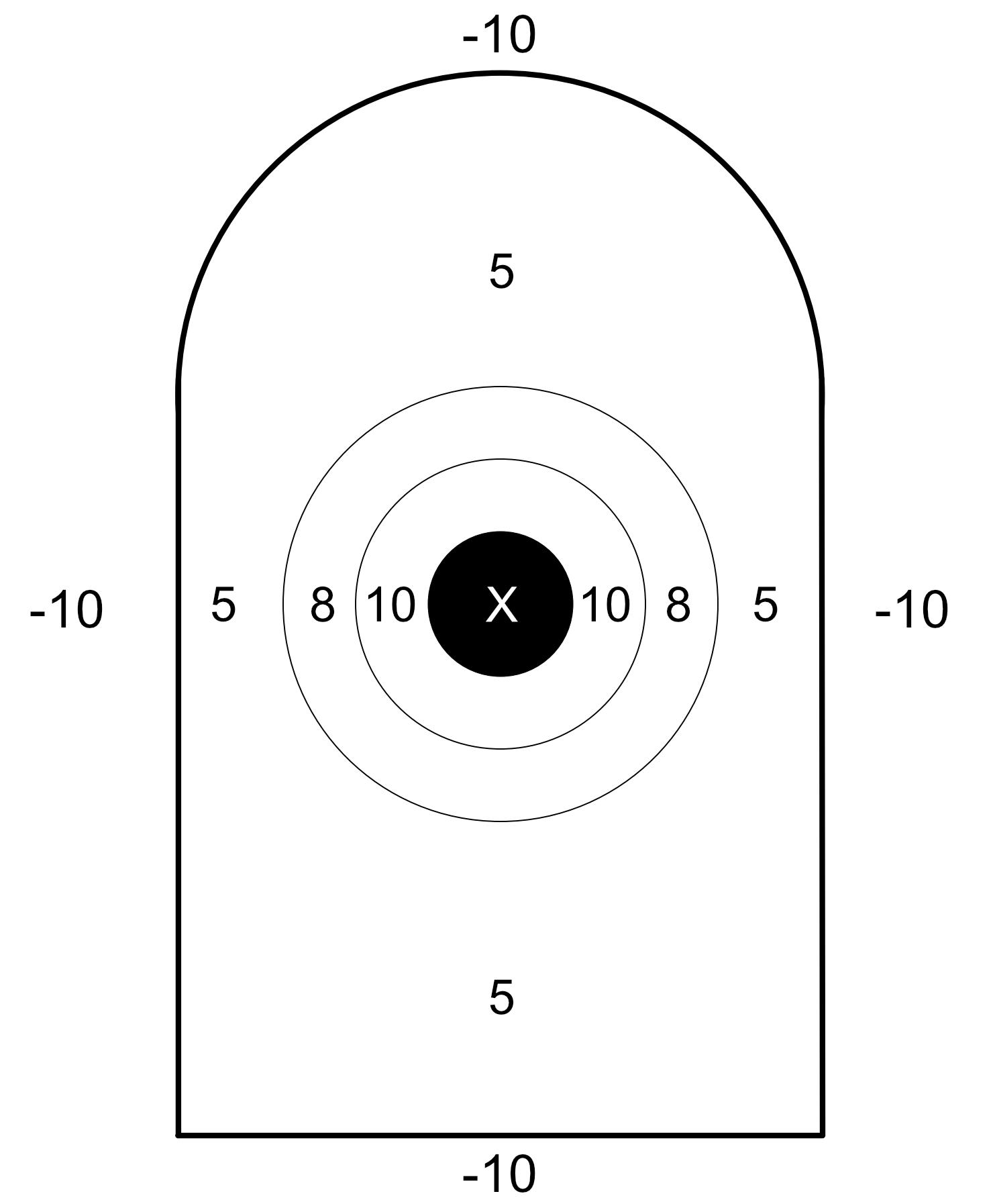
To complete this course of fire, and match, you will need several NRA AP-2 targets, otherwise known as the scaled “tombstone” target. If you don’t want to buy them, which I would suggest, you can find printable versions online.
The AP-2 has four scoring zones. The middle black is the 1.1″ X-ring and is worth 10 points. The next ring out is the 2.2″ A-ring, and is also 10 points. Then a 3.3″ B-Ring worth 8 points. The remainder of the area inside the tombstone is 5 points.
Since we’re focused on the practical implications of marksmanship, and we’re accountable for every bullet, any hit outside of the tombstone is a -10 point deduction.
In other words, not missing is more important than going fast. If this seems like too difficult a task for the target, then I suggest going back and spending more time mastering your pistol marksmanship fundamentals.
Setup
Place two AP-2 targets on the backer. Separate them as much a possible, ideally with a three-foot spacing center to center.
You will start facing the target and pistol holstered in a safe position. If shooting a double action/single action, then the hammer is down. If shooting a single action only, then the hammer is cocked and the safety is on. Hands should be up in the “surrender” position.
The exception is for rimfire, where you may start in the low ready position.
Some stages allow for the kneeling position to aid with accuracy. If you choose to shoot from the kneeling, you must still start standing in the surrender position with hands up. On start, you may draw and drop to kneeling for the string.
Part 1: Practical Pistol Shooting
Part one consists of four stages. Each stage has the same number of shots and has three strings of fire. The difference from stage to stage is increasing the distance and adjusting the time standard. Note that action pistol use time limits per string, and there are no points for going faster. The goal is earning as many points as you can within the allowed time.
Reloading and Reholstering
Every string starts with a holstered pistol (exception: rimfire). After shooting each string, return the pistol to a safe condition (i.e. hammer down or safety on) and reholster. After every six shots, you will reload off the clock. This enables revolvers to participate. So after Strings 1 and 2 of each stage (which total 6 shots), reload and reholster before doing String 3, which is also 6 shots. Reload again, reholster, and then move on to the next stage.
Stage Breakdown
| Stage & Distance | String | Task (2 Targets) | Time Limit | Position / Notes |
|---|---|---|---|---|
| STAGE 1 3 Yards | String 1 | 1 shot each (2 total) | 3 Seconds | Standing position only |
| String 2 | 2 shots each (4 total) | 4 Seconds | Standing position only | |
| String 3 | 3 shots each (6 total) | 8 Seconds | Standing position only, transition to Weak Hand Only after the draw | |
| STAGE 2 5 Yards | String 1 | 1 shot each (2 total) | 4 Seconds | Standing position only |
| String 2 | 2 shots each (4 total) | 5 Seconds | Standing position only | |
| String 3 | 3 shots each (6 total) | 6 Seconds | Standing position only | |
| STAGE 3 9 Yards | String 1 | 1 shot each (2 total) | 5 Seconds | Standing or Kneeling position |
| String 2 | 2 shots each (4 total) | 6 Seconds | Standing or Kneeling position | |
| String 3 | 3 shots each (6 total) | 7 Seconds | Standing or Kneeling position | |
| STAGE 4 16 Yards | String 1 | 1 shot each (2 total) | 7 Seconds | Standing or Kneeling position |
| String 2 | 2 shots each (4 total) | 10 Seconds | Standing or Kneeling position | |
| String 3 | 3 shots each (6 total) | 15 Seconds | Standing or Kneeling position |
Part 2: Speedload Challenge
Part 2 also consists of four stages with one string each. The setup is the same, with two targets positioned on the backer with about 3 feet of space from center to center. You will want fresh targets. Begin with the weapon holstered and in a safe condition with hands up in the surrender position (exception for rimfire, which may start from the low ready).
| Stage & Distance | Time Limit | Firing Procedure (2 Targets) | Total Rounds |
|---|---|---|---|
| STAGE 1 3 Yards | 18 Seconds | Draw and fire 3 shots at each target, Reload, then fire another 3 shots at each target with Weak Hand Only. | 12 |
| STAGE 2 5 Yards | 16 Seconds | Draw and fire 3 shots at each target, Reload, then fire another 3 shots at each target with Strong Hand Only. | 12 |
| STAGE 3 9 Yards | 18 Seconds | Draw and fire 3 shots at each target, Reload, then fire another 3 shots at each target Freestyle. | 12 |
| STAGE 4 16 Yards | 23 Seconds | Draw and fire 3 shots at each target, Reload, then fire another 3 shots at each target Freestyle. | 12 |
Performance Benchmarks
For a postal match, each competitor will perform both parts of the course of fire one time. Each part has 480 available points, and one run through maximum of 960 points.
The Minimum Capable Citizen standard is at least 576 points (60% of max). The Martial Marksman standard is at least 768 total points (80% of max available).
Of course, you can always go for more, and you’ll probably have to in order to be competitive in a postal match. For a benchmark of performance, though, achieving 768 combined points (especially with your carry/defensive gun) is a solid performance.
Available Divisions
As with our other pistol matches, here are the available divisions to submit entries for. Remember, one entry consists of both Part 1 and Part 2.
| Division | Max Weight | Capacity | Optics / Electronics | Notes & Restrictions |
|---|---|---|---|---|
| Practical Optics | 45.0 oz | 21+1 | Slide-mounted & WML | SAAMI defensive calibers (>.32 to <.45). Disallowed Modifications: Compensators, porting, frame mounted optics, gas pedals, or any other conspicuous modification that wouldn’t typically be found on a factory pistol designed for service use. |
| Practical Irons | 45.0 oz | 21+1 | Iron Sights only | Same caliber/mod restrictions as Practical Optics. |
| Carry Gun | 32.0 oz | 15+1 | Slide-mounted & WML | Max barrel length: 4.1″. |
| Back Up Gun (BUG) | 26.0 oz | 6+1 | Any | Max barrel for semi auto: 3.5″ Max barrel for revolver: 2.5″ Must be .32 caliber or larger. |
| Rimfire Optics | N/A | N/A | Optical Sights | Rimfire only. Comps/ports allowed. |
| Rimfire Irons | N/A | N/A | Iron Sights | Rimfire only. Comps/ports allowed. |
| Revolver | N/A | N/A | Irons or Optics | Any centerfire revolver. Limited to 6 rounds loaded. |
| Open | N/A | N/A | Any (Frame-mounted included) | Catch-all for comps, ports, gas pedals, or heavy builds. |