I’m that guy that goes to the range and disappoints the counter staff every time when I turn down their offer to sell me whatever targets they have available. Honestly, having your own stash of targets that you consistently train with is an important element of making progress from session to session. Over time, I’ve built up a ridiculous stockpile of targets. Sometimes it’s to experiment, and other times its because I have a purpose in mind.
Today I want to share what I think the best targets to keep on hand are for most people, most of the time. You can buy these now and start stacking them deep so that you have a steady supply for training and competition purposes.
I’ll share the top three, and then throw in a few others to add for good measure.
The Big Three Targets
Let’s start with the most important ones first. With these three targets, you can basically practice, perform, and evaluate just about any kind of shooting discipline you can think of. It’s not just about the scoring rings themselves, which are valuable, but also about the sizes and shapes of the scoring zones and how they help you focus on speed over precision if the shooting style calls for it.
The NRA B-8
You knew this one was coming. The B-8 is traditionally for bullseye competition where it is the regulation target for 25 yard timed and rapid fire stages. To save space on the backer, you can also get the slightly smaller B-8 Repair Center, which has the same size black bull and scoring rings, but only goes out to the 7-ring instead of the 5 ring.
As done in our precision pistol course of fire, you can do a decent job repurposing the B-8 as a slow fire target by reducing the point value of each ring from the face value, which saves you the need from also having to get the B-6 for 50 yard slow fire or the B-16 for 25 yard slow fire (nod to YouTuber JaredAF for that tip).
Police1 did a whole writeup on the tactical utility of the B-8 as well. The 5.5″ black is a decent approximation for the vitals cavity of heart or head shot. If you fold the sides of the target back and touching the edge of the black, it ends up being a really decent stand-in for a USPSA A-Zone.
The B-8 also very similar dimensions to the FBI IP-1 qualification target, so you can use it for that handgun qualification as well.

The NRA TQ-4
The TQ-4 is a 100 yard smallbore training target, designed as a single target version of the larger A-25 target. Long ago, I identified the TQ-4 as the official rifle target for the Everyday Marksman because of it’s 8″ black, which provides a fantastic “all around” target for practical shooting. You could choose to either use the scoring rings as you would in competition, or just focus on making hits in the black as an example of “good enough” marksmanship under time pressure. Think of it like you would an 8″ pie plate with additional functionality.
Why 8″, you ask? Well, if your goal is defensive shooting then you have to consider the size of a human “effective hit” zone. John Simpson pointed out that most people think in terms of the target facing you directly, but in the real world targets rarely do that. They may be moving side to side, leaving you with a different profile to aim at. So rather than using the widest possible target of a front facing human, we should narrow down to the typical sternum-to-spine measurement of 10″. The TQ-4 has a 10″ ring, as well, but getting solid hits in the 8″ ring ensures a little bit more confidence.
Additionally, an 8″ ring conveniently divides for MOA measurement purposes. Place it at 200 yards and it’s a solid 4 MOA standard to work for.
Since it’s a rifle target, it also works well for basic marksmanship competition scoring.
IPSC Classic “Turtle” Target
For action shooting disciplines, it’s hard to beat USPSA and IPSC. As much as I like what I’m seeing from other disciplines like GPA and PCSL, IPSC/USPA are ubiquitous and the associated targets easier to find. The simple layout of A-Zone, C-Zone, and D-Zone are easy to understand and score. Additionally, it takes pressure away from “over aiming” to get a higher point value in the traditional targets.
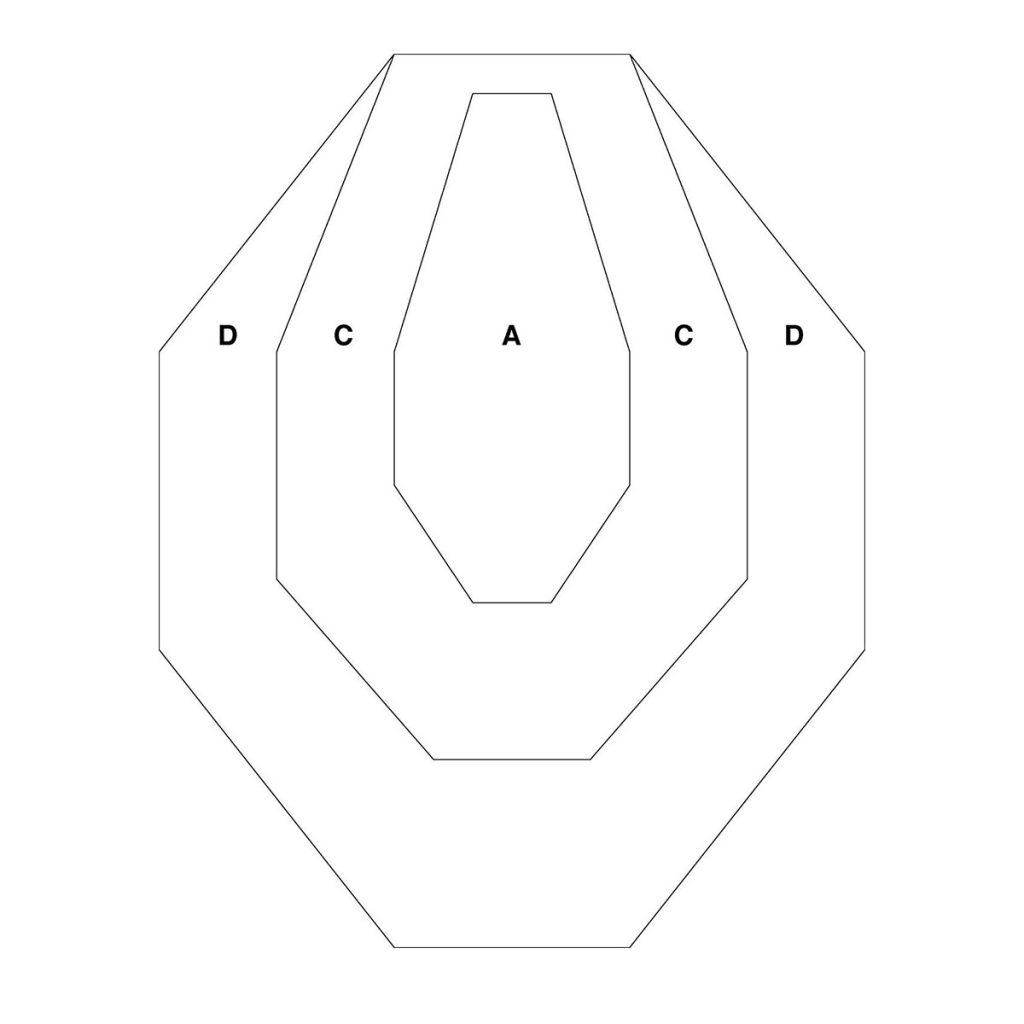
But why the turtle target instead of the more common humanoid silhouette? The simple answer is that there are still many ranges out there that don’t allow human silhouette targets on the range for liability purposes. The classic “turtle” target avoids that issue while still presenting a reasonable target to practice with.
These types of targets are great for hit factor type scoring, where your performance is a mixture of how many hits were in the A-Zone divided by how long it took you to take the shots.
You most commonly find these targets in cardboard format, the same as you would see at a competition, but you can also find them in paper format for easy transport to a range.
Room for Two More
With the big three out of the way, we’re in the territory of targets that are also helpful but not completely necessary. I still keep several of these on hand for either training or competition purposes, but also because they make good targets for general range use and teaching beginners.
NRA AP-2 “Tombstone” Action Pistol Target
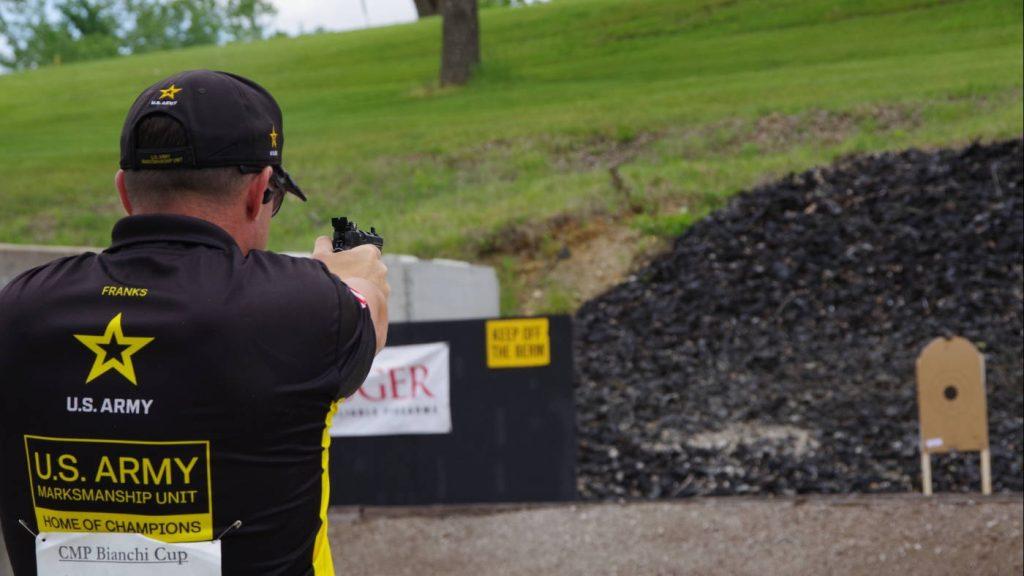
Action pistol shooting, also known as the Bianchi Cup, isn’t as popular as some of the other modern “go fast” disciplines- but that’s a shame. I’ve seen Action Pistol described as one of the most difficult shooting sports due to it’s mix of high accuracy and speed requirements. The traditional target of the discipline is the AP-1, printed on cardboard and placed at distances up to 50 yards. It’s a 23″ x 35″ tombstone with a 4″ bull in the middle.
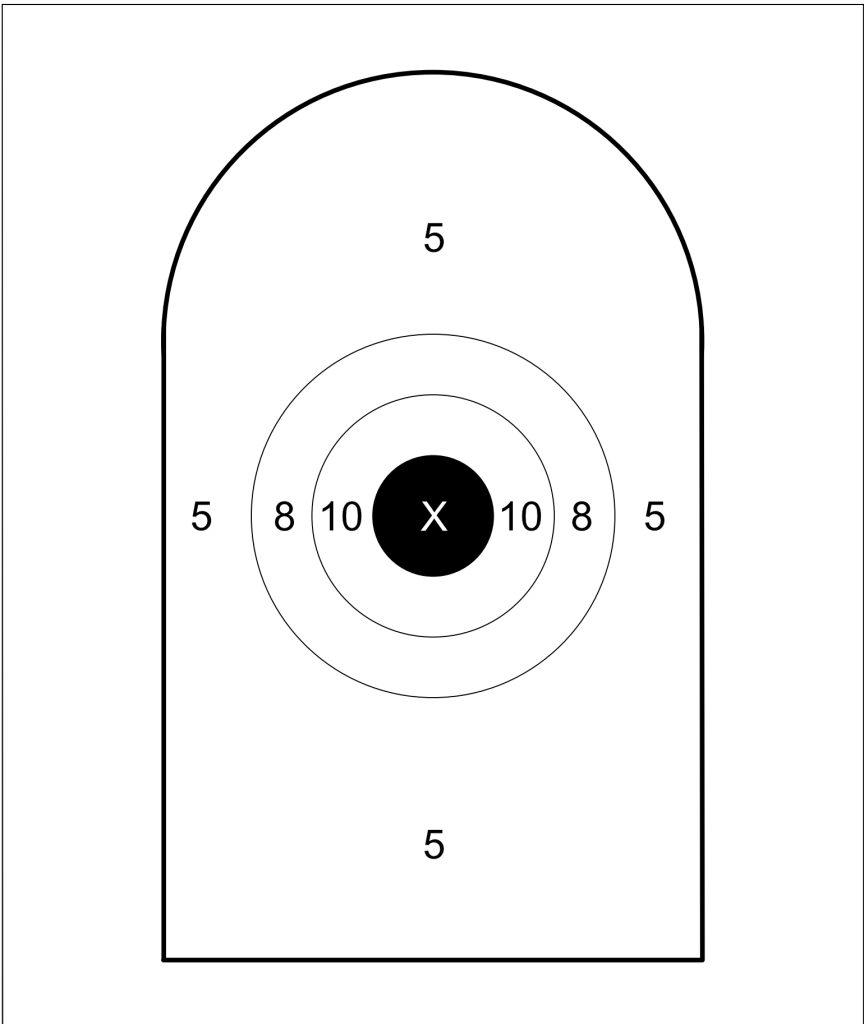
The AP-2 is a scaled down version of the AP-1 designed for indoor use up to 50 feet (~16 yards) while presenting a similar level of difficulty. The black bull is 1.1″, with the A and B rings being 2.2″ and 3.3″ respectively (worth 10 points and 8 points, respectively). The overall tombstone is 5″ wide and worth 5 points. When the goal is mixing precision with speed, this is a fantastic target for indoor use, and you can stockpile a lot of them without taking up much space. If you’re frugal, you can find them as printable versions, too.
The basic trick is that you can look at any course of fire in the Action Pistol rules and swap “yards” for “feet” with the AP-2. So a 25-yard stage with an AP-1 becomes a 25-foot (~9 yards) stage with the AP-2.
The 5″ width of the AP-2 tombstone is also a good approximation of the center mass vital zone in a defensive scenario, while the 3.3″ 8-ring also makes a good stand-in for the CNS “off switch” while the rest of the tombstone has a rough dimensional association with a head.
Absent any other options, you could use either a TQ-4 or an IPSC Turtle target as a “body” and the AP-2 as the “head” in an improvised silhouette scenario.
IALEFI-QT Paper Target
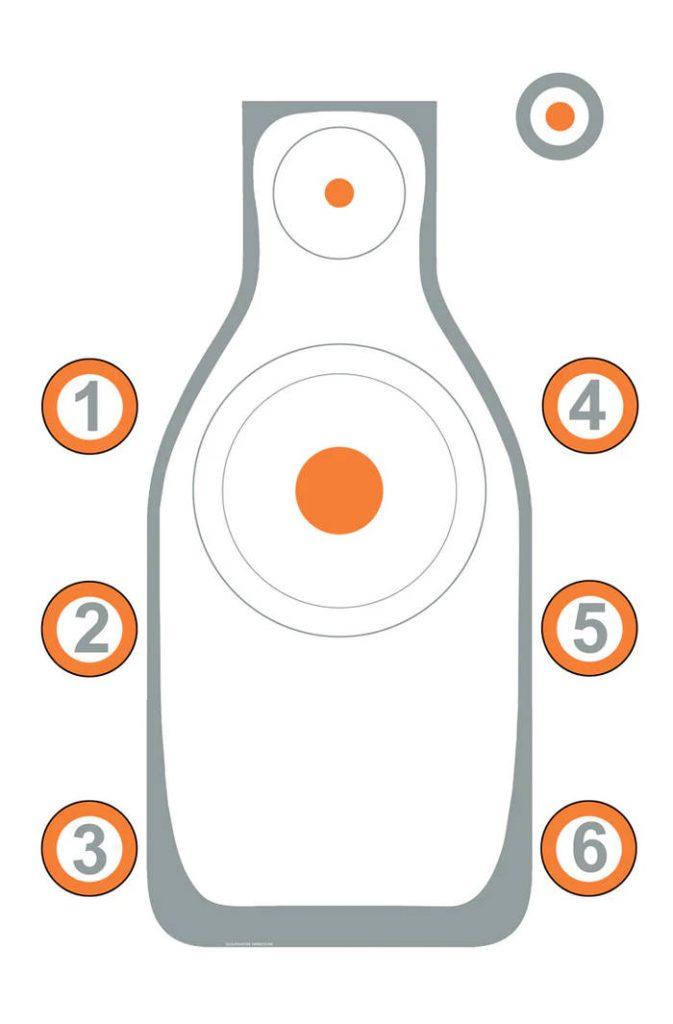
For ranges that allow it, the International Association of Law Enforcement Firearms Instructors (IALEFI) Qualification & Training target is often my go-to training target for defensive purposes. It combines many different targets and ideas into a single 23″ x 35″ sheet of paper.
It has the same general bottle shape as the FBI ‘Q’ target. At center mass, it has a 3″ orange bull surrounded by both 8″ and 10″ rings. The head zone has a 4.5″ circle with a 1″ orange bull. In all, this target encompasses nearly every other function in this list in some way, except for scoring rings for precision shooting.
Additionally, this target has six numbered dots for doing things like transitions or drills where someone else calls out some sequence of numbers and you have to shoot them in that order such as “THREE, FOUR, ONE!” These circles also work well for practicing precision, as with the dot target below.
In all, if there was only one target to use for most Martial Marksman training, I would probably take this one.
…And if You Still Have Space
Like I said, I’ve used and keep a lot of targets. If you still have room for more, then here are some additional suggestions that I think have value.

Appleseed AQT
I got a ton of mileage out of these early in my shooting journey. They’re classic, and they work well. The full size AQT has scaled “D Silhouettes” to represent 100, 200, 300, and 400 yard targets while shooting at 25 yards. You can conveniently and repeatedly run the Appleseed qualification on yourself and evaluate your progress.
Additionally, I’d suggest grabbing a stack of the 100-yard rimfire silhouettes. These are scaled so you can use the same target to represent the D-Silhouette at scale. So placing it at 25 yards represents 100, 50 yards, is 200, 75 yards is 300, and 100 yards equals 400 yards.
Find all of these in the Appleseed Target Store.
Scaled Bullseye Targets
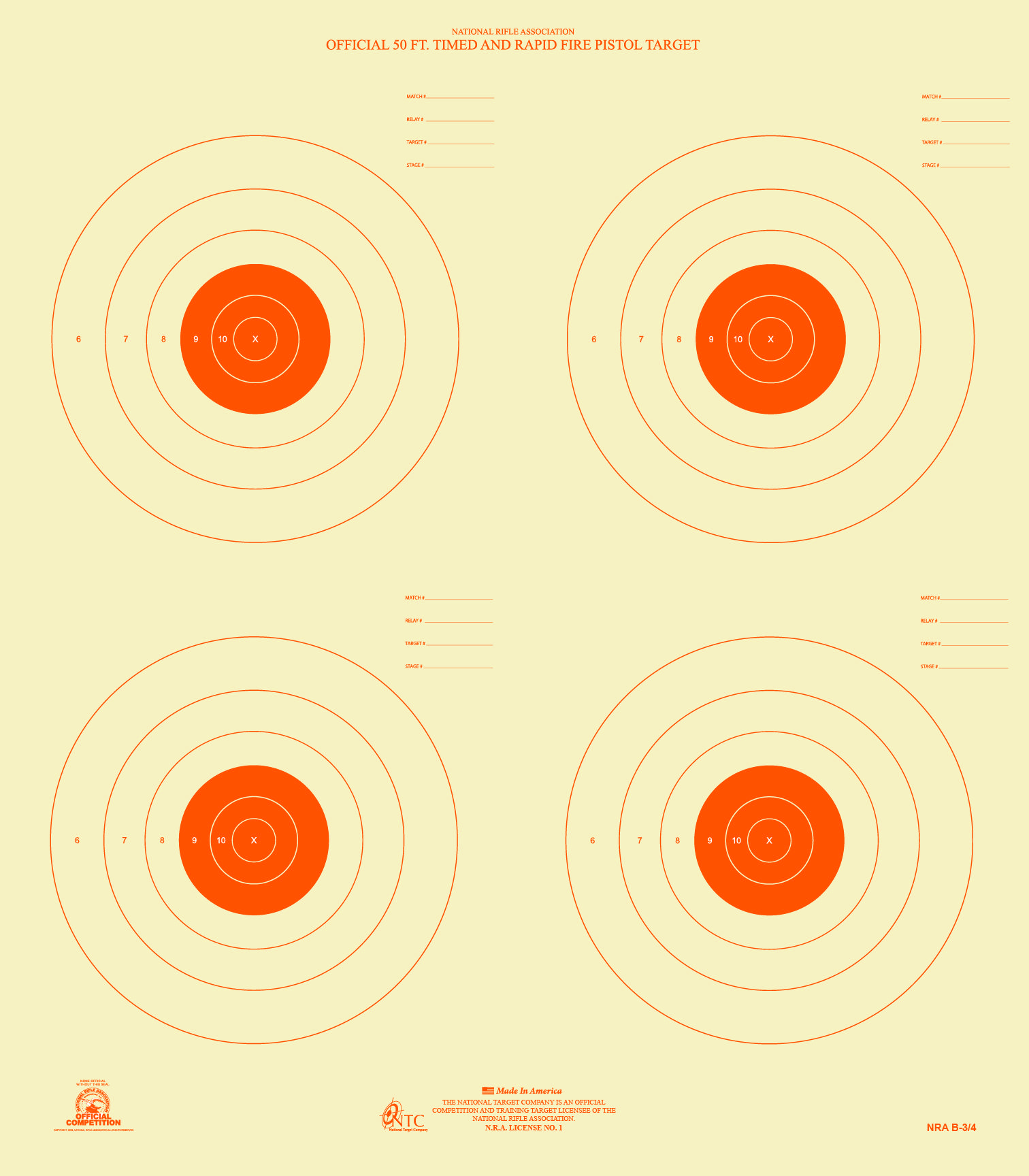
While the B-8 is a great all-purpose target for many things, if you’re trying to keep things a bit closer distance and evaluate your skills then it’s hard to beat the scaled versions. My personal preference is the B-3, which is the 50-foot timed/rapid bullseye target. For training purposes, it’s effectively the same difficulty and scaled target size as the B-8 at 25 yards, but you shoot it at 50 feet (~16 yards). If simulating slow fire, then do the exact same “minus 1” scoring.
My personal favorite is the B-3/4 “Orange” that uses orange bulls instead of black (for easy spotting) and places four targets on the same sheet of paper. That lets me do one sighter, one slow fire (with minus 1 scoring), the timed stage, and rapid fire, all on one sheet with no need to swap targets.
As a bonus, this target works really well for zeroing and accuracy testing since there are multiple bulls on the same paper and hits against the orange are more visible than against a black.
If you don’t care about having four bulls on one sheet, you can also get the B-3 in other high vis colors like light blue.

DOT-4 Target
My first exposure to this style of target was during the Appleseed Pistol event. My preference is the DOT-4, which has 24 dots arranged in a grid. Each dot is 3″ wide. This style of target is great for focusing in on small groups with your weapon done repeatedly. It’s very similar to the classic dot torture drill in that regard.
I also like to use these targets for load evaluation as I’m working up a recipe. I can use each row for checking how a particular batch or grain weight of powder works for me and keep it all on one target.
There You Have It
Most of my readers haven’t put much thought into keeping stacks of various targets available for training purposes. Unless they’ve engaged in various postal matches with me over the years, there wasn’t much need to. That said, there is huge value in having a consistent target and training regime so you can measure your progress. In the long run, buying your own targets is cheap compared to what your average range charges you to buy theirs when you show up to shoot.