We’re back with another look at a pistol optic. As you well know by this point, I’ve been on a speed run testing optics that many people haven’t heard of or considered, especially those not made in China. The RMSx is Shield’s entry into the competition optic market, particularly focused on action shooting like USPSA, IPSC, iDPA, and PCSL. It’s most direct competitors are the Trijicon SRO (which I also have) and the Holosun 507 Comp.
Previously, I’ve taken a look at Shield’s enclosed duty gun optic, the AMS and their slightly larger mini dot designed for rifles and sub guns: the SIS-2. I think both of these are fine optics, and make good choices for their respective markets if the need makes sense. Given how similarly both of them performed optically and mechanically, I had a pretty good idea what to expect going into the RMSx.

The Bottom Line Up Front
I bought the Shield RMSx with my own funds- the glass lens version with a 4 MOA dot. I grabbed it on sale for $369, which just seemed to good to pass up on an optic with MSRP in the $489 range. For the price I paid, and maybe even at the normal non-sale price, the RMSx seems like a heck of a deal if you can put up with it’s little quirks.
The glass is totally clear with no tint, and it is the widest lens of any pistol optic I’ve been able to look through. Combined with the very thin frame, this makes visibility through the optic something to truly behold. The deck height is also super low, making it practical to use standard height irons on any pistol.
The optic uses a bottom-mounted CR2032 battery and relies on automatic brightness only. I ran the optic in a variety of environments from dim indoor ranges to bright white targets on a blazing West Virginia day, and never lost visibility of the dot. There is no auto shutoff or anything like that. Shield estimates 2-3 years of battery life with the automatic setting and storing the optic in a dark environment. I’m not a fan of having to remove the optic to swap out the battery, but it is what it is and the RMR is the same way (and people love it despite that).
My only two real complaints is that the RMSx has the same “issues” as the other Shield sights I’ve tested. The illumination brightness happens with pulse width modulation, which means you can detect distinct on/off traces as you quickly pan or shake the optic around. You would never see this just aiming at a target, but you can for sure detect it as you pan horizontally while maintaining target focus.
Secondly, shield continues to use their “infinite adjustment” for elevation and windage. This mechanism has no clicks whatsoever. I’ve never had it lose zero on me, but I still find it unnerving.
in all, those complaints are minor. I really like this optic, and I think it makes a fantastic competition option for anyone using the RMSc footprint. You can usually find it on sale from most reputable dealers.
Unboxing and Mounting the Shield RMSx
Since I covered it so thoroughly in my post about the SIS-2, I’ll forgo the history of Shied as a company. Simply know that they are the OG of the miniature red dot world, and were the first to really bring it to market. They hold several contracts with the UK Ministry of Defense, and you might think of them as roughly the “British Trijicon.” The reason they aren’t more popular in the US is…well…I don’t know. Perhaps it’s just a crowded market and they don’t have a large marketing budget.
The RMSx came in the same kind of black plastic clam shell box with a card stock wrapper as everything else. In the box was the sight, a cover, three sets of mounting screws, battery, shim plate (for additional clearance if needed), T-10 Torx wrench, and a zeroing tool.
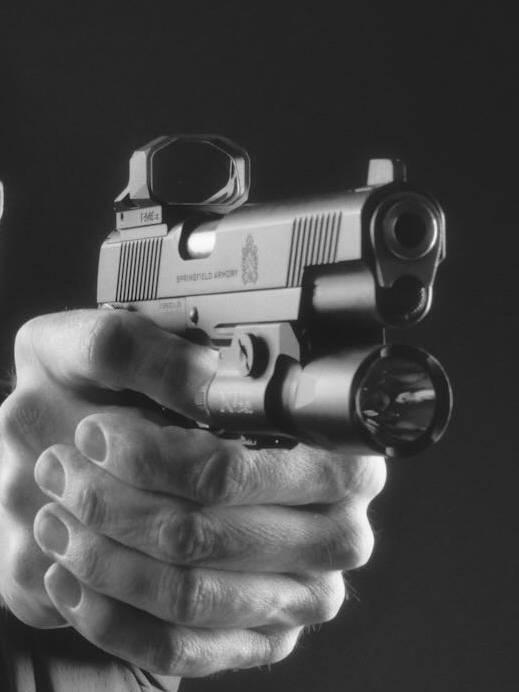
For testing, I mounted the RMSx to my Springfield Operator AOS 1911. The narrow base of the optic fit well with the narrow slide of a 1911. The window itself then swoops hilariously wide out from there.
The lens on my model is glass, and the housing is aluminum. The lens if oval-shaped, wider than it is tall. At the rear, a set of support arms extend up to help prevent bending and such.
Once mounted, there is no access to the battery compartment. I don’t like this, but I understand why it happens. To take advantage of economies of scale, Shield uses the same electronics package in all of their RMS/RMSc footprint optics. With the SIS-2 and AMS, they were able to place the battery compartment on the side of the optic because the enclosure offered enough real estate. With the RMSx (or any of the standard RMS optics), there isn’t enough housing to do that, so under the base it goes.
Once mounted, the only other screws on the RMSx are for adjusting elevation and windage.

Optic Performance
Continuing the trend of previous experience, the RMSx lens has zero tint to it. I couldn’t help but wonder if this would cause problems with contrast in challenging lighting conditions, but it was perfect. 10/10 here.
The wide window is beautiful, really.
Dot Performance & Brightness
The RMSx utilizes automatic brightness only. i was a bit worried about this going in, though prior experience was telling me it would probably be fine with Shield. I just like having control in the event something doesn’t go right.
Luckily, the optic worked perfectly. I shot it at two indoor ranges with mixed lighting conditions, lots of dry fire in my home office, and a four-hour training course on a bright West Virginia day. At no point did I think the optic couldn’t keep up with ambient lighting conditions.
However, I still wouldn’t want to run this if I was pairing it with a bright weapon light indoors. The automatic brightness worked well, and could even deal with the light of a Surefire X300 Turbo, but I still would want more control.
The 4 MOA dot appears very crisp to my eyes, maybe better than the SIS-2 and AMS to be honest. Perhaps it has to do with the glass lens?
I did run into the same issue of pulse width modulation, though. Scanning the optic in front of my field of view results in a morse-code like series of red dashes to my eyes. i don’t actually find this that annoying, but i know some people do.

Zeroing
As with previous Shield dots, you zero this with a very small hex wrench. Shield provides a dial that helps you estimate MOA as you rotate it- but I honestly ignored that and just adjusted POA/POI at 15 yards until it matched up for me. The adjustments have no clicks or anything to indicate how far you’ve gone. i find this disconcerting, but that’s probably because I’m just not used to it.
To date, i’ve not had this adjustment style lose zero on anything.
As a bonus, the deck height of the optic is so low that you can get a fantastic iron sight picture cowitness through it using standard height irons.
Holster Quirks
One more note I’ll add is that the housing of the RMSx did interfere a little bit with my Dara holster. By “interfere” I mean that there was a very slight amount of rubbing. It never actually caused an issue with drawing or holstering, but the OD green kydex did leave a little bit of residue on the bottom flanks of the housing from touching.
Wrapping Up
In all, I like this optic a lot. For now, I’ve now mounted it to my Ruger Mark IV. I intend to use the Mark IV in competitions like Steel Challenge and other marksmanship-focused efforts. The RMSx gives me a wonderful sight picture for that, and I think it’s going to great there.
Do I think the RMSx is worth buying? If you can get it on sale, especially for less than $400, then I think it’s a killer option. Even at a more normal price in the mid $400 range, it is still a great optic that isn’t made in China. My Trijicon SRO will probably remain the primary optic on my CZ P10 for now, but I was mightily tempted to swap it out for the RMSx. The convenience of being able to swap out the battery without dismounting the optic won out along with manual brightness controls and less interference with my holster. Since rimfire games usually don’t require a holster, then it’s great fit over there.
Depending on how matches go with the Mark IV, though, I may yet still switch over to the RMSx.