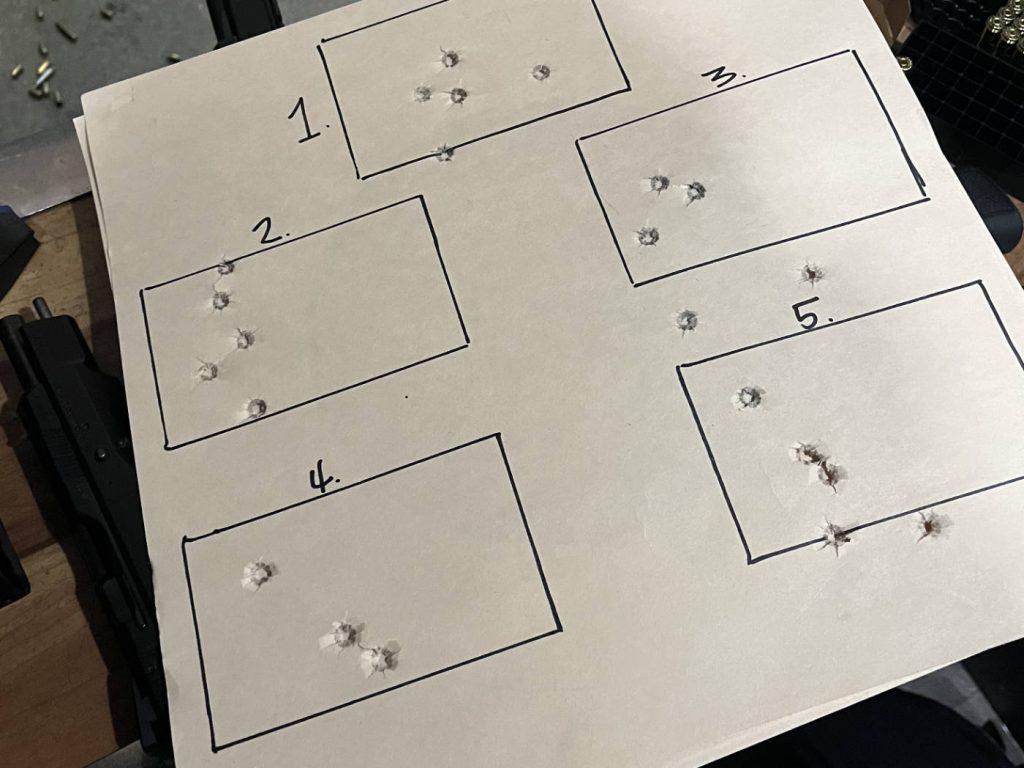
This is the official course of fire for the Everyday Marksman Practical Pistol Course (PPC) match. Designed as a direct nod to the historical law enforcement roots of the NRA Police Pistol Combat match, we’ve streamlined it a bit for ease of execution and target selection.
To complete this course of fire, you will need 50 rounds, a 25-yard lane, and an IPSC Classic “Turtle” target.
Match Intent
Approach this match in the spirit of the Martial Marksman. Seek expertise in you regular equipment, such as the gun you carry day-to-day, rather than hyper-specialized competition gear.
This course of fire bridges the gap between our Precision Pistol and Action Pistol courses. The practical pistol course, in particular, has roots to in various police or federal agency qualifications. Postal matches aside, this also makes a fantastic personal benchmark test to see where you’re at at the start or end of a range session.
Required Target and Scoring
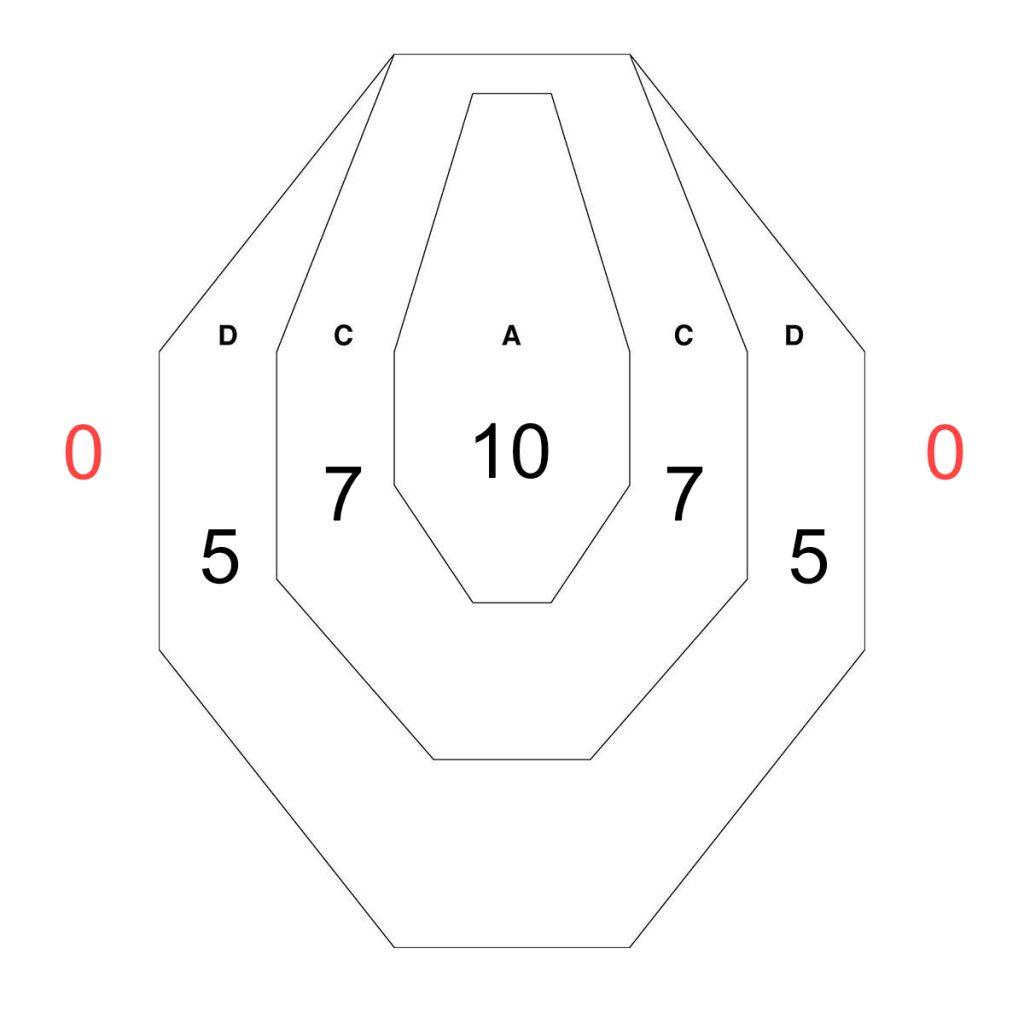
For this course, use the IPSC Classic “Turtle” Target (cardboard or paper equivalent).
With a total of 50 rounds fired across the match, a perfect score yields 500 points. Scoring is simple:
- A-Zone: 10 Points
- C-Zone: 7 Points
- D-Zone: 5 Points
- Misses (Outside scoring border): 0 Points
This match is timed, but there are no points for going faster. You are better served by using available time to make accurate hits on the A-Zone than you are trying to go faster and becoming sloppy in the process.
Setup & Firing Rules
- Start Position: Weapon loaded and securely holstered. Unless otherwise specified, hands begin in the “Interview” position (hands in front of you as if you were having a conversation or taking notes). Exception: Rimfire shooters may start from a 45-degree low ready position.
- Condition: If shooting a double-action/single-action (DA/SA) pistol, the first shot of every string must be broken double-action (hammer down). Single-action only (SAO) pistols start cocked with the manual safety engaged.
- Stage Loading: Reloads are part of the course of fire, so all magazines should only be loaded to five rounds at a time. Exception: Six-shot revolvers may be loaded to six rounds to accommodate speed loaders, but only five rounds will be fired at a time.
The 50-Round Course of Fire
Stage 1: 3 Yards
Stage Round Count: 10 Rounds total (Two magazines of 5 rounds each)
- String 1: From the holster, draw and fire 5 rounds Strong Hand Only (SHO). Time limit: 6 Seconds. Reholster.
- String 2: From the holster, draw, switch hands and fire 5 rounds Weak Hand Only (WHO). Time limit: 8 Seconds. Reholster.
Stage 2: 7 Yards
Stage Round Count: 10 Rounds (two magazines of 5 rounds each)
- Setup: Load two magazines with five rounds each
- Stage Execution From the holster, draw and fire 5 rounds freestyle (two-handed), perform a reload, and fire another 5 rounds freestyle.
- Time Limit: 15 Seconds.
Stage 3: 15 Yards
Stage Round Count: 15 Rounds
- Setup: Load three magazines with 5 rounds each.
- Stage Execution: From the holster, draw and fire 5 rounds Freestyle
- Perform a reload, fire 5 rounds Freestyle
- Perform a second reload, and fire 5 rounds Weak Hand Only (WHO).
- Time Limit: 30 Seconds.
Stage 4: 25 Yards
Stage Round Count: 15 Rounds
- Setup: Load three magazines with 5 rounds each.
- Stage Execution: From the holster, draw and fire 5 rounds Strong Hand Only (SHO),
- Perform a reload, drop to kneeling, and fire 5 rounds Kneeling Freestyle.
- Perform a reload, and fire 5 more rounds Kneeling Freestyle.
- Time Limit: 45 Seconds.
Performance Benchmarks
In this 50-round course of fire, there is a maximum possible 500 points available. The Minimum Capable Citizen standard is 300 points (60% of max), while the Martial Marksman standard is 400 points (80% of max).
Of course, you can and should strive to achieve higher than that.
If you’re able to keep all hits within the D-Zone (5 points) and under the par time, then you’re nearly to the 300 point minimum. The real magic is working up to the 400-point martial marksman standard, which will require keeping hits mostly in the A and C-Zones.
| Stage & Distance | String | Task | Time Limit |
|---|---|---|---|
| STAGE 1 3 Yards | String 1 | Draw and fire 5 rounds Strong Hand Only (SHO) | 6 Seconds |
| String 2 | Draw, safely transfer, and fire 5 rounds Weak Hand Only (WHO) | 8 Seconds | |
| STAGE 2 7 Yards | Single String | Draw and fire 5 rounds freestyle, reload, then fire 5 more rounds freestyle | 15 Seconds |
| STAGE 3 15 Yards | Single String | Draw and fire 5 rounds freestyle, reload and fire 5 rounds freestyle, reload and fire 5 rounds Weak Hand Only (WHO) | 30 Seconds |
| STAGE 4 25 Yards | Single String | Draw and fire 5 rounds Strong Hand Only (SHO), reload, drop to kneeling and fire 5 rounds kneeling freestyle, reload and fire 5 more rounds kneeling freestyle | 45 Seconds |
Taking It to the Next Level
Once you can consistently meet the 400-point Martial Marksman standard within the existing par times, you can increase the difficulty by introducing hit factor scoring.
For this version, keep the existing par times as the maximum allowable time caps for each string or stage. However, instead of simply recording whether you made the par time, record the actual time it took to complete each string.
Any miss outside the D-zone scores 0 points and adds a +5 second penalty to your final time.
At the end of the course, total your points and divide that number by your adjusted total time.
Performance Score = Total Points ÷ Adjusted Total Time
Where:
Adjusted Total Time = Raw Total Time + 5 seconds per miss
This gives you a hit factor-style performance score that rewards both accuracy and efficiency. The goal is not merely to go faster. The goal is to produce accurate hits in less time.
A good initial performance goal is 4.00 to 4.99. If you can reach 5.00 or better, you are performing well. However, do not move to this scoring method until you are already scoring 400 or better on the standard course of fire with the normal par times.
Accuracy comes first. Speed only matters after you can consistently keep your hits where they belong.
Available Match Divisions
As with our other pistol matches, here are the available divisions to submit entries for.
| Division | Max Weight | Capacity | Optics / Electronics | Notes & Restrictions |
|---|---|---|---|---|
| Practical Optics | 45.0 oz | 21+1 | Slide-mounted & WML | SAAMI defensive calibers (>.32 to <.45). Disallowed Modifications: Compensators, porting, frame mounted optics, gas pedals, or any other conspicuous modification that wouldn’t typically be found on a factory pistol designed for service use. |
| Practical Irons | 45.0 oz | 21+1 | Iron Sights only | Same caliber/mod restrictions as Practical Optics. |
| Carry Gun | 32.0 oz | 15+1 | Slide-mounted & WML | Max barrel length: 4.1″. |
| Back Up Gun (BUG) | 26.0 oz | 6+1 | Any | Max barrel for semi auto: 3.5″ Max barrel for revolver: 2.5″ Must be .32 caliber or larger. |
| Rimfire Optics | N/A | N/A | Optical Sights | Rimfire only. Comps/ports allowed. |
| Rimfire Irons | N/A | N/A | Iron Sights | Rimfire only. Comps/ports allowed. |
| Revolver | N/A | N/A | Irons or Optics | Any centerfire revolver. Limited to 6 rounds loaded. |
| Open | N/A | N/A | Any (Frame-mounted included) | Catch-all for comps, ports, gas pedals, or heavy builds. |