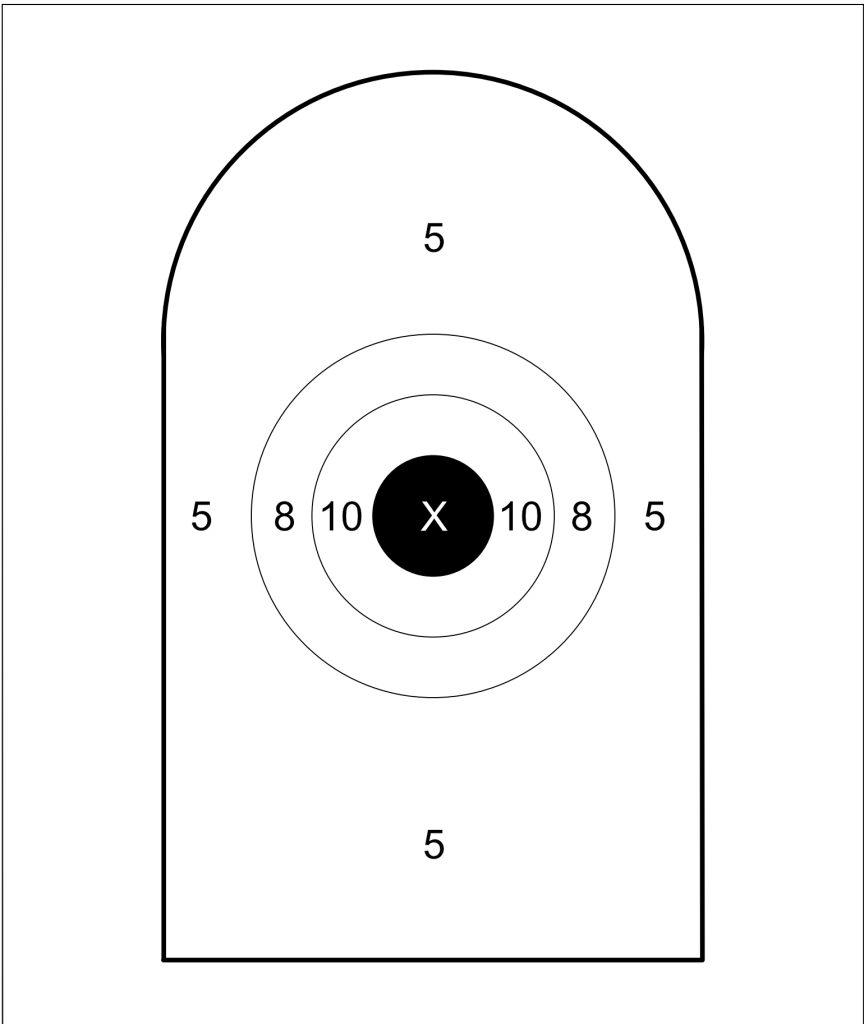
This test involves 10 shots fired at 10 yards with a time limit of 10 seconds at an NRA B8 target. It’s a quick evaluation of any shooter’s ability to manage their handgun sights, grip, and recoil. Ken Hackathorn popularized it, and Larry Vickers is also a proponent and has used some alternate scoring similar to his Modified Humbler.
I consider this to be an intermediate level drill for after someone has grasped the fundamentals and is working to balance that accuracy against speed over multiple shots.
Setting Up
This drill uses an NRA B8 target or B8 repair center. Place it at 10 yards and load your pistol with 10 rounds. Set a timer for 10 seconds and assume a ready position with the pistol.
Note: If you’re shooting a gun with less than 10 rounds, such as a revolver with 5 or 6 shots, then add five seconds to the time limit to account for the reload.
Execution
On start, fire 10 rounds at the target within the time limit. There are no points for going faster here, so learn to shoot with a cadence that balances your shot-to-shot split time with proper aiming and trigger control. As mentioned before, a great way to do this is with a shot timer and metronome.
After the string, score the target point value based on the B8 scoring rings.
| Procedure | Details |
|---|---|
| Distance | 10 Yards |
| Target | NRA B-8 Repair Center |
| Start Position | Ready Position (Pistol at 45° or low ready) |
| Course of Fire | Fire 10 rounds in 10 seconds (15s for low-capacity firearms) |
Good: 90 – 94 Points
Passing: 80 – 89 Points
Failure: < 80 Points
Goals and Benchmarks
The passing standard for the 10-10-10 is 80 points. “Good” requires 90 points, while “Excellent” is better than 95 points.
Alternate Scoring
As with the Modified Humbler, you can apply the Larry Vickers -0/-1/-3/-5 method. Any hit in the 5.5″ black of the B-8 is -0. Any hit outside the black but within the 7 ring is -1 point. A hit outside the 7 ring but on paper is -3, and missing the paper is -5.
I don’t think this alternate method works as well if only running the drill one time, but if you aggregate it over several (say about 6 times), it makes more sense. Try not to drop more than 10 points.
Alternate Target
Aside from the B-8, I think this particular drill is a good fit for the AP-2 tombstone. The tombstone is 5″ wide, about the same as the black of a B-8, but slightly taller. You could apply scoring as described in the target’s writeup, or apply Vickers-style “down points” with a hit inside the 3.3″ b-ring as -0, a hit outside that but on the tombstone as -1, and a hit outside the tombstone but on paper as -3.
Progression Method
The 10-10-10 does not just have to be run one way. Greg Ellifritz did a nice writeup on this. The original version calls for starting at the low ready, but once you can consistently perform well from that position, start working from the draw.
Try this progression of the 10-10-10 and see how it shakes out:
- From the low ready, freestyle
- From the draw, freestyle
- From the low ready, strong hand only
- From the draw, strong hand only
- From low ready, weak hand only
- From the draw, [draw and switch to] weak hand only
Doing all six iterations leads to 60 total shots, similar to the Modified Humbler. Aim for an aggregate score of 480 if using the scoring rings of a B-8, or dropping no more than 10 points if using the Vickers method.
If you get good at that, try it with the AP-2 tombstone and its tighter scoring standards.
Remember, this drill is always 10 seconds, so don’t feel pressure to try and beat the clock by a significant margin. Use the time to make the shots count.