

This is the standard practical rifle course of fire used for both postal matches and personal benchmarking. It has roots in USPSA/IPSC scoring, though simplified with a single target to account for the fact that many people don’t always have the ability to set up multiple targets. Rather than the other courses of fire where we used fixed times and points, this one uses hit factor scoring where you add up the points and divide it by the total time taken.
Match Intent
As always, we intend this match to be run in the spirit of the Martial Marksman. That is to say that you should approach it as if it’s an evaluation of your skill with the same rifle and equipment you would show up to defend your community with tomorrow if Scenario-X kicked off. Minimize the temptation to game the system and equipment for an extra edge. This is more about you evaluating your own current skill than winning a friendly match amongst friends.
Also, this match is intended for defensive rifles and carbines. You could probably get away with a PCC, semi-auto rimfire, and maybe even a lever action- but the latter will be a distinct disadvantage in reload times. If you’re fine with that, then carry on.
The Defensive Rifle Course of Fire
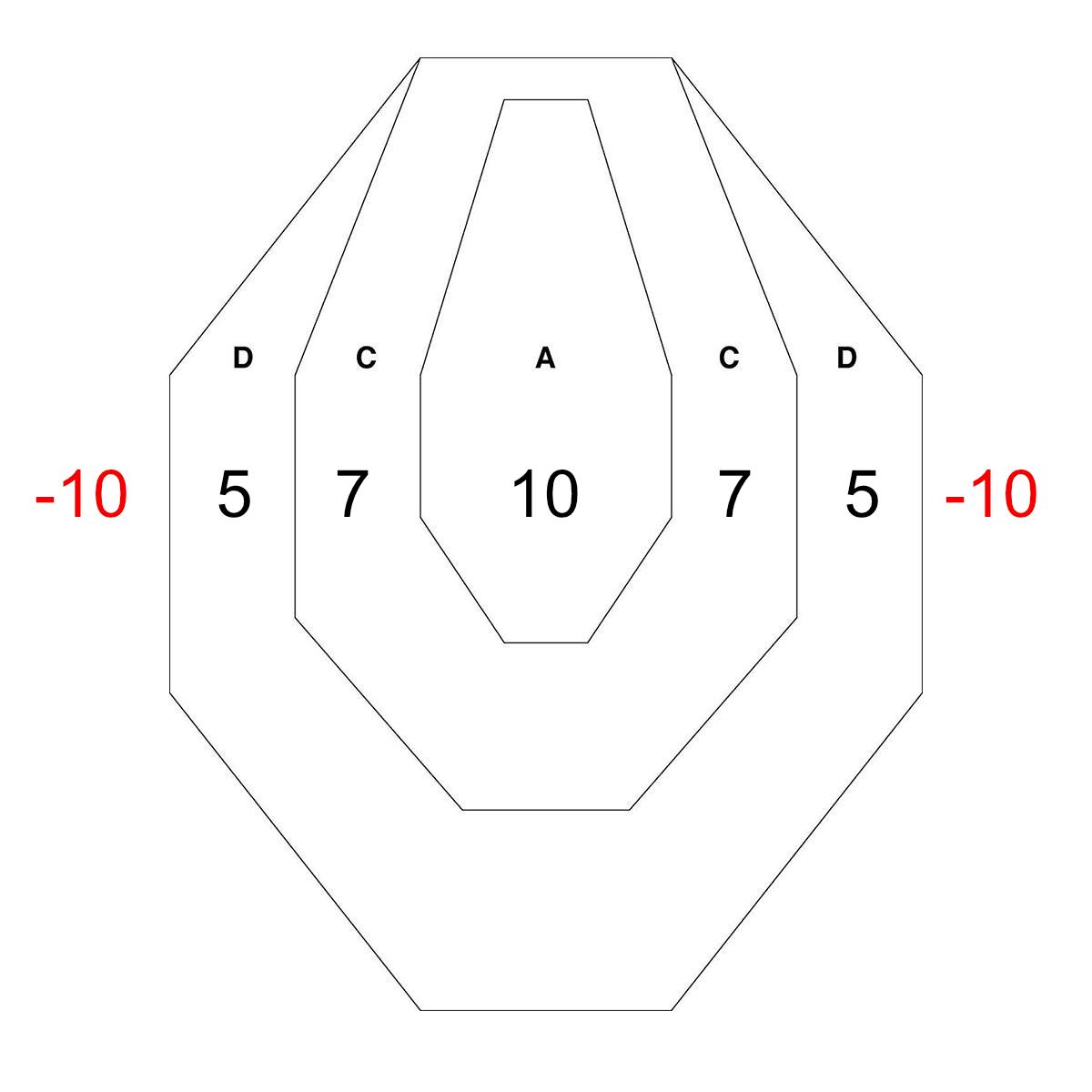
This course of fire requires 20 shots, and takes place between from 15 to 50 yards. For a target, we use the IPSC Classic “Turtle” type silhouette. I chose this because many ranges still do not allow using human-shaped silhouettes for liability reasons, but the dimensions of the target still work well for training purposes. You can find these in bulk packs of 100 paper targets, or opt for the standard cardboard version.
For our purposes, a hit to the A-Zone is 10 points, the C-Zone is 7 points, the D-Zone is 5 points. Missing the target completely comes with a -10 point penalty. This reinforces the idea that, particularly for civilians, missing is unacceptable since we’re accountable for every bullet that leaves the weapon.
To complete this course of fire, you also need a shot timer. This is a non-negotiable. You could have gotten away with other timer methods in the other courses of fire, but precise timing is an integral part of how this course of fire works.
Scoring
This course of fire uses hit factor scoring. At the end of each stage (or two), add up the points for your hits and then divide it by the total number of seconds it took to make those hits.
So, for example, let’s say that in 20 shots you made 10 A-Zone, 6 C-Zone, 3 D-Zone, and had one miss.
That means (8×10) + (6×7) + (3×5) – (1 x 10), or 80+42+15-10 for a total of 127 points. Let’s assume your total time was 22.34 seconds.
127 / 22.34 = 5.68 hit factor. Your final score is 5.68 for the course of fire.
For a full match entry, which consists of three runs through the course of fire, you add together all points for all three runs (600 points max) and divide it by the total seconds for all three runs.
For example: (127 + 160 + 145) / (22.34 + 28.42 + 26.74) means 432 divided by 77.5 for a hit factor of 5.574. This is the final score for the match entry.
Execution
| Stage & Distance | Task (1 Target) | Rounds | Position & Notes |
|---|---|---|---|
| Stage 1 15 Yards | 2 sets of Hammer Pairs (2 shots each). | 4 | Standing. Low Ready. Record time for each string of shots. |
| Stage 2 15 Yards | 2 shots, Reload, 2 shots. | 4 | Standing. Bolt-lock reload (Start with 2 in rifle). Record time for all four shots |
| Stage 3 25 Yards | 3 shots Standing, Reload, 3 shots Kneeling. | 6 | Standing to Kneeling transition. Record time for all six shots |
| Stage 4 50 Yards | 6 shots Kneeling. | 6 | Start Standing. Drop to Kneeling on buzzer. Record time for all six shots |
| ENTRY TOTALS | 3 Runs / 3 Targets | 60 Rounds | Final Hit Factor: (Total Pts / Total Time) |
Details
This course of fire has four stages. Stages 1 and 2 are at 15 yards. Stage 3 is at 25 yards, and Stage 4 is at 50 yards.
All stages begin with the shooter holding the loaded rifle in a standing low ready position, safety on. You need to document your time for every string of shots and stage so that you can add it all up at the end.
Stage 1
For Stage 1, you will do two sets of hammer pairs. So, on start, raise the rifle and take two rapid shots at the target as quickly as you can while maintaining control (remember, -10 points for every miss). Document your time for each string.
Stage 2
For stage 2, you will start with two remaining shots in the magazine and have another magazine at the ready with an additional two shots. Shooter begins standing in the low ready position. On start, raise the rifle and fire another hammer pair, perform an emergency reload and fire another hammer pair. Document the time for all four shots.
Now is a good time to score your hits so far as you move the target for the next stage.
Stage 3
For Stage 3 (now at 25 yards), start with three shots in the gun and three more in a magazine at the ready. Shooter begins standing in the low ready position. On start, fire three shots at the target, perform an emergency reload, and fire three more shots from the kneeling position. I suggest working the reload and dropping to kneeling at the same time, simulating “taking cover” in a real situation.
Document the time for all six shots and score the target.
Stage 4
For Stage 4 (now at 50 yards), start with six shots in the gun. Shooter begins standing in the low ready position. On start, drop to kneeling or squatting position and take six shots on the target.
Document the time for all six shots and score the target.

Score and Repeat
With one run complete, sum up the total points earned from 20 shots (200 points max available) and add up the cumulative time for each stage. Set a fresh target or put pasters on the target if using cardboard, and repeat the whole sequence again two more times. The reason for repeating is evaluating consistency through these stages rather than one really good or really poor run.
Benchmarks and Goals
Since the final score is a hit factor rather than a raw point value, the benchmark works differently.
For Minimum Capable Citizens, the goal is a hit factor of at least 3.0.
The Martial Marksman standard is a hit factor of at least 5.0 Of course, you should try to exceed this (and will likely have to in order to win a match), but it serves as a solid benchmark for your own performance.
Rifle Divisions
For this course of fire, we simplify the divisions a bit in the spirit of the match.
- Defensive carbine (any semi-auto rifle)
- PCC (any semi-auto pistol caliber carbine)
- Manual Action (any centerfire manually-operated action like a lever or bolt gun)
- Rimfire (any semi-auto rimfire rifle or carbine)


