Can you put accountable hits on a small target, at a realistic distance, on demand?
The “Old West Test” (also called the 5/5/5 drill or Playing Card Test) is a convenient way to way to answer that question because it’s fast, cheap, and honest. It’s also a great “skills check” drill to keep in your regular rotation, especially if your practice tends to drift toward comfortable distances and generous targets.
This drill is commonly associated with Tom Givens (of Rangemaster), but was introduced to me by Uncle Zo and his writing. The version I’m describing here is the modern 5/5/5 standard: five rounds, five yards, five seconds, into a vertical 3″ x 5″ index card.
The story goes that in the Old West, it was a challenge to put a playing card up on a tree and see who was a capable shooter. Playing cards back then were larger than we think of today, about 3″ x 5″.
Target Audience
As a beginner, you’ll find that this drill is a challenge, but it’s not insurmountable. It’s a best fit for someone early in their pistol journey who wants a simple and repeatable test to see if they are progressing. Experienced shooters with a lot of time in practice and in training should have little trouble with it.
Once you’re hitting it consistently, there are ways to make it more difficult, which we’ll get to.
| Course of Fire Specification | |
|---|---|
| Distance | 5 Yards |
| Target | 3″ x 5″ Index Card (Vertical Orientation) |
| Start Position | Low Ready |
| Volume | 5 Rounds |
| Par Time | 5 Seconds |
Set Up and Execution
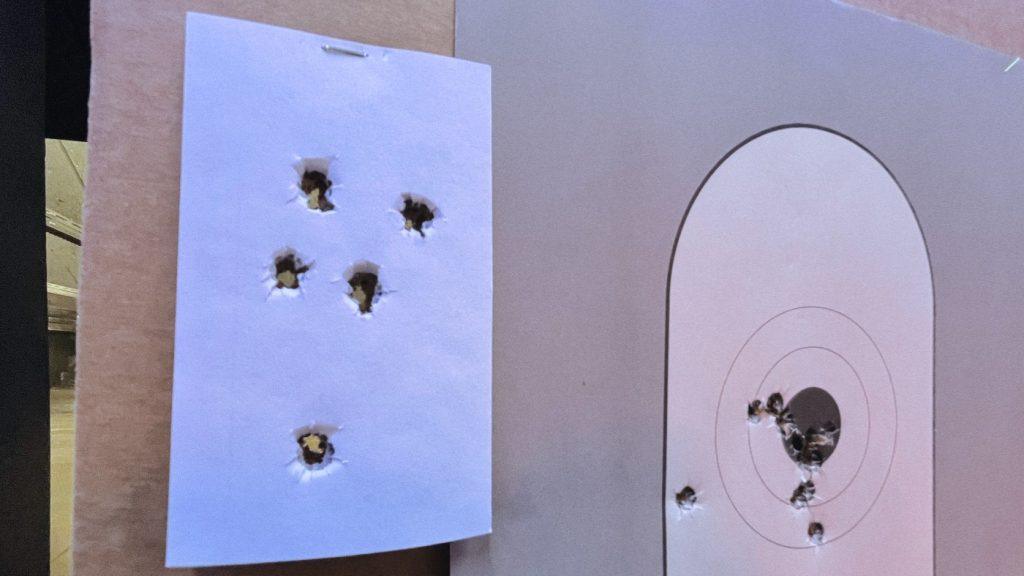
Place a single 3″ x 5″ index card on the backer, vertical orientation, and set it at 5 yards. My personal preference is do put three cards up at once so I can run the drill back to back.
Load your pistol with five shots and set a par timer for five seconds. Assume the low ready position.
On start, fire five shots into the index card. Only clean hits in the card count, no edge breaks or anything like that. If you put all five shots into the card within five seconds, you’ve completed the test.
Alternative Target
Index cards are plentiful and easy to find. If you’re looking to use targets that I’ve already suggested before, then the AP-2 Tombstone is a great fit. The B-Ring is 3.3″ in diameter, so barely wider than the 3″ of the index card, but also nearly 2″ shorter. If we math it out, then the index card has an area of 15 square inches and the B-Ring of the AP-2 is 8.55 square inches- just a little bit more than half.
The AP2 ends up being a great way to increase the challenge, or make it easier if you use the entire tombstone.
Upping the Difficulty
Aside from a smaller target, you can also increase difficulty by introducing more movement. If you can perform the test as-written three consecutive times with an index card, then push it by starting from a holster. If you get proficient from the hip holster, start doing it from concealment.
Once you can do that, start decreasing the time standard.
Tom Givens suggests a personal goal of 2.5 seconds from the ready position, and 3.5 seconds from concealment.
Another option is to simply increase the distance from 5 yards to 7 yards, then 10.
Making it Even Harder: 5-Yard FO
This is a semi-related version that I picked upf rom Greg Ellifritz, and it’s probably deserving of it’s own post. The “FO” in this case stands for “F’ over.” You can shorten it to “FYFO.”
With the 3×5 index card at 5 yards, we’re going to increase the round count from 5 shots to 10 shots and introduce some more complexity.
Here’s the sequence, done all in one go:
- Draw and fire five shots with both hands
- Shoot three rounds strong hand only
- Transition to weak hand and fire two more shots
The par time to complete all 10 shots is 9 seconds.
That’s it. Have fun, train hard.